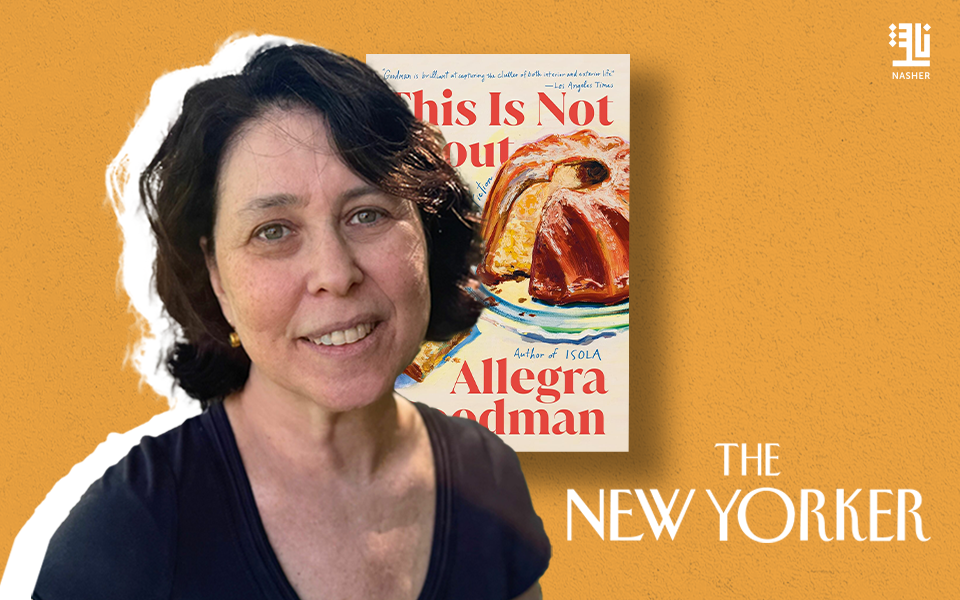
In a literary interview published by The New Yorker, the American writer Allegra Goodman reflects on the contours of a long-term narrative experiment, one that can be read as a “serial novel” composed of interconnected short stories. The conversation coincides with the release of her new story collection, This Is Not About Us, due out in February 2026. The book brings together texts Goodman has written over the course of a decade, all revolving around a single extended family, the Rubinstein’s, whom she describes as a multifaceted gemstone, understood only when turned slowly toward the light, from different angles, where ages, roles, and relationships intersect in a dense human tapestry.
Goodman explains that assembling these stories into one volume allowed her to see the family as a cohesive narrative unit rather than as a set of isolated tales. Each story is told from a different perspective, enabling the reader to encounter the characters both from within and from without, and to observe how misunderstandings take shape, how bonds sometimes fray, and how they may later be repaired. She emphasizes that she does not side with one character against another; instead, she leaves space for all voices, seeking to capture the true complexity of family relationships as they are lived, not as they are simplified.
Among the collection’s standout pieces is “Deal-Breaker,” one of the final stories Goodman wrote for the book. It centers on Pam, a woman in her fifties who is involved with a divorced man who has a daughter. Goodman notes that the story emerged at the suggestion of her editor, who observed that while all the cousins in the book had stories of their own, Pam remained on the margins. From that observation, Goodman began to explore Pam’s life, her late-stage solitude, her emotional entanglements, and her relationship with parents who have no grandchildren, and who nonetheless yearn for that bond, even if it arrives in the form of a “partial” or tangential grandchild.
The interview also delves into Goodman’s distinctive use of small, everyday details to carry profound emotional weight, a defining trait of her work. A cancelled outing, a postponed meeting, or a homemade dessert can become the spark for long-lasting estrangement or deep personal disappointment. Goodman stresses that such details never end in themselves; they stand in for larger, unspoken emotions. She concludes by noting that the stories in “This Is Not About Us” ultimately converge into something very close to a single novel, multi-voiced and multi-chaptered, told with the quiet cadence of daily life and its hidden depth.