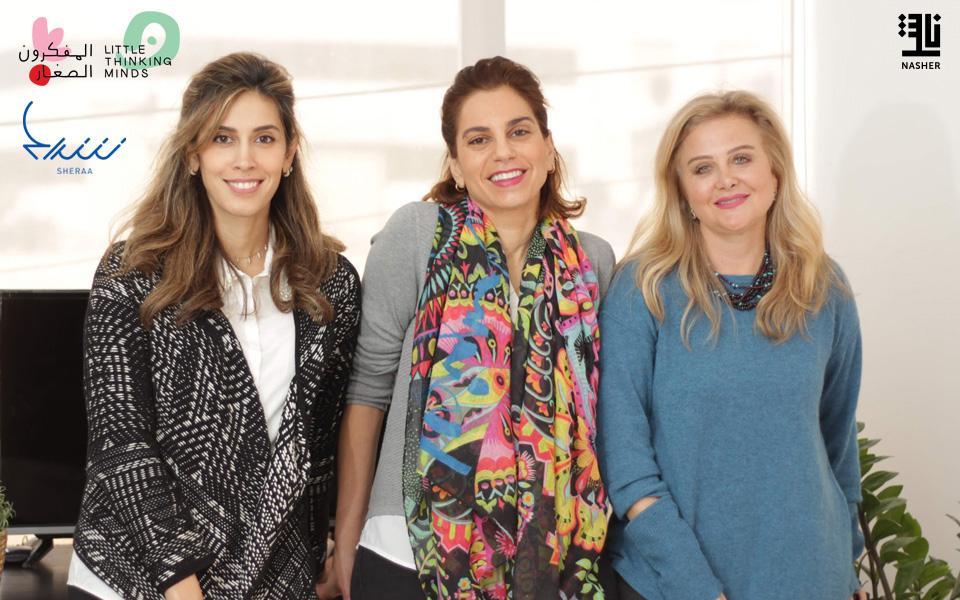
The “Little Thinking Minds” company, established in Amman in 2004, is considered one of the pioneering companies in the field of educational technology. It focuses on creating advanced digital solutions and platforms to improve the Arabic language learning for school children in the MENA region and beyond. The Company recently won first place in the “Access Sharjah” program, which was launched by the Sharjah Entrepreneurship Center (Sheraa), in celebration of selecting Sharjah as the World Book Capital 2019.
“Nasher” interviewed Salwa Katkhuda, partner and development manager at the Little Thinking Minds, in this dialogue:
What was the goal behind launching Little Thinking Minds?
My partners Rama kayali and Lamia Tabaa founded the Company in 2004 to provide an entertaining content for young children in Arabic, but the idea soon developed when I joined as a partner and development manager in 2017. We started developing digital platforms to improve the learning outcomes of the Arabic language and to serve schools in the Middle East North Africa. Today, our educational solutions are used by more than 130,000 students at schools and homes.
You primarily focus on producing videos and digital applications. Do you have an interest in entering the printed publishing sector?
In fact, we have no intention of entering the printed publishing sector because of our conviction of the importance of meeting the different learning styles of students.
You recently won first place in the “Access Sharjah” program, what does this award mean to you? And how will it affect your services and your business strategy?
We are very pleased to have won the first place in the Access Sharjah program, and we look forward to investing in the technology used in our programs and the available content to provide comprehensive resources for the Arabic language for all children and teachers in the region.
Is there any cooperation between you and Emirati and Arab publishing houses?
Of course, out of our commitment to provide the best for our children and teachers, we work with the leading publishers of children’s books in Arabic to ensure the quality of the content of books and their suitability to our customs and traditions, and we look forward to greater cooperation with the Emirati publishing houses in the upcoming period.
Your content has reached Arab and foreign schools worldwide.. How was the interaction?
We offer beginners and non-Arabic speakers a rich program to learn Arabic in line with international standards and national curricula. For Arabic speakers, we offer them a program called “I Read Arabic”, which enables them to learn at their own pace by reading books and watching various videos.
How do you see the future of the Arab children’s book?
Reading is important for improving children’s communication skills. It also helps to develop creativity and enhance their understanding and perception of their surroundings, and thus developing their mental health and emotional intelligence.