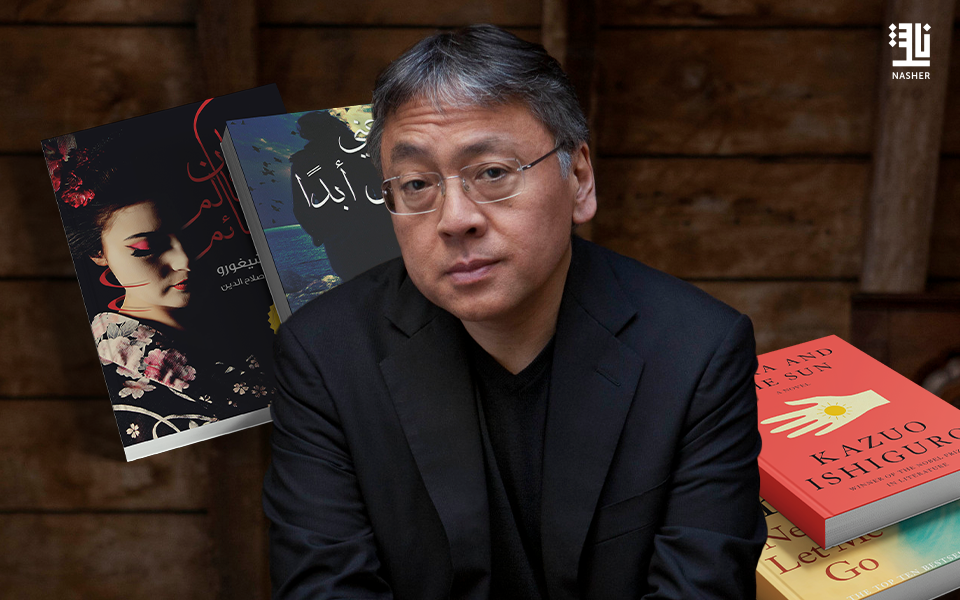
Since winning the Nobel Prize in Literature in 2017, Kazuo Ishiguro’s name has once again taken a prominent place in global literary conversations. Yet this “renewed discovery” does not mean the British-Japanese author had ever truly disappeared. Since his celebrated novel The Remains of the Day (1989), a poignant portrayal of duty and loyalty set against the backdrop of historical change, Ishiguro has consistently produced works that defy the boundaries of time and identity, opening windows onto the world from unexpected angles.
What defines Ishiguro’s world is that his characters always seem to be racing against time, not time in its mechanical sense, but as a subtle force shaping consciousness and redefining truth. In The Remains of the Day, we follow the journey of Stevens, an English butler traveling through the countryside, on a trip that is outwardly geographical but inwardly a reconciliation with a burdensome past. This immersion in the details of memory, where storytelling itself becomes an act of recollection and selection, was the seed that would later bear fruit in bolder forays into imagination and existential speculation.
With the dawn of the new millennium, Ishiguro began stepping into a broader space between realism and metaphor, as in Never Let Me Go (2005), where he used a science fiction framework to probe profound ethical questions about fate and freedom. Here, time was no longer just a backdrop; it became a narrative mechanism pressing on the characters, forcing them to confront the reality of their own “temporariness” in a world where others control their destiny. This ability to carry questions of identity from a traditional human context into futuristic settings cemented Ishiguro’s place as a writer who transcends literary genres.
In his latest novel, Klara and the Sun (2021), Ishiguro reaches the height of blending the intimate with the philosophical. Through the voice of Klara, a robot companion for children, we see the world through eyes both innocent and programmed for meticulous observation, as the author poses a fundamental question: Can artificial intelligence truly understand the essence of love and loyalty? Here, time is not only what humans live through, but also what artificial beings experience as they contemplate the fading of their role in the lives of others.
Remarkably, even as Ishiguro’s settings have shifted from English manors to futuristic laboratories, he has remained faithful to his central themes: the fragility of memory, the weight of the past, and the ongoing search for identity in the face of forces greater than the individual. This constancy of core concerns, coupled with innovation in form and medium, is what makes rediscovering him such a rewarding and inspiring experience. A reader returning to The Remains of the Day after reading Klara and the Sun will find an invisible thread linking the butler reflecting on his life to the robot striving to grasp what it means to be human.
Rediscovering Ishiguro, then, is not merely a return to a literary archive, it is an invitation to reconsider our own relationship with time and identity, and how we reshape ourselves through every transformation. His works remind us that a truly great story does not fade with the years; it renews itself with each new reader and each stage of life, revealing that what he wrote decades ago still mirrors our questions today, and perhaps those of tomorrow as well.