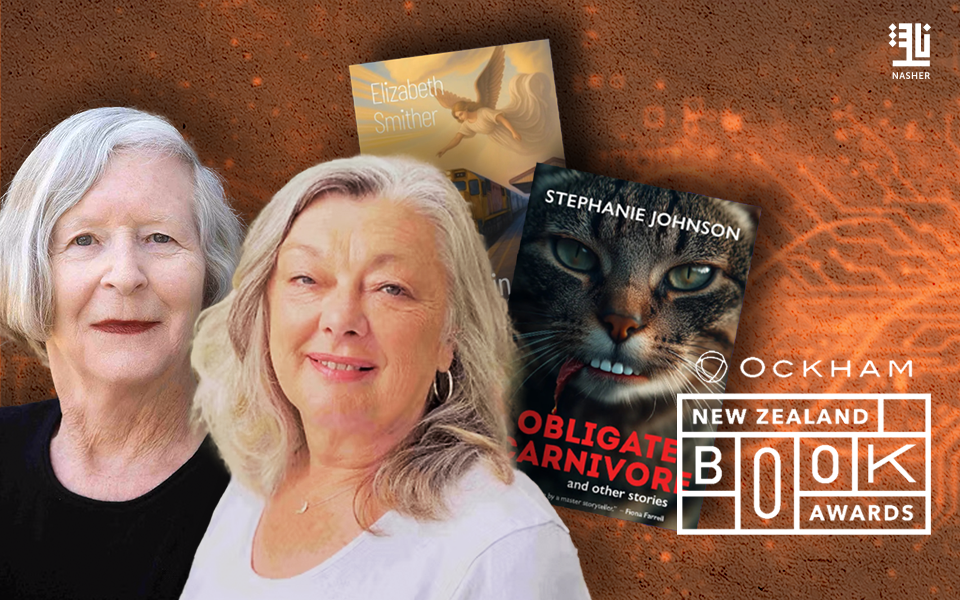
The books of two award-winning New Zealand authors have been disqualified from consideration for the country’s top literature prize because artificial intelligence was used in the creation of their cover designs.
Stephanie Johnson’s collection of short stories Obligate Carnivore and Elizabeth Smither’s collection of novellas Angel Train were submitted to the 2026 Ockham book awards’ NZ$65,000 fiction prize in October, but were ruled out of the competition the following month in light of new guidelines around AI use.
According to RNZ, the organisers were alerted by a bookseller who spotted what they believed to be AI imagery on the submitted covers. After the publisher confirmed that the covers did indeed contain elements generated with AI, the books were removed from eligibility for the 2026 awards. Both books were published by Quentin Wilson Publishing, an independent house in Christchurch.
The New Zealand Book Awards Trust introduced a new rule in August stating that any book entered for the Ockham awards must not contain AI material of any kind. This applies not only to the writing but every visual element, including the jacket artwork, illustrations, or any decorative imagery.
The publisher said the book covers were submitted before the rule was announced in August.
In a statement, Smither said the designers spent hours working on the cover of her book, which features a steam train and an angel “half-obscured in the smoke”, inspired by artist Marc Chagall’s figures.
“It is them I am most concerned about: that their meticulous work … is being disrespected,” Smither said.
Both Smither and Johnson have previously judged categories of the Ockham awards, and both said the covers were given very little consideration.
“The contents and the close reading were everything,” Smither said.
The use of AI in creative fields has come under increasing scrutiny as the technology has evolved, with some groups developing ways to counter its influence.
Nicola Legat, the chair of the book awards trust, which administers the Ockham awards, said the trust takes a “firm stance on the use of AI in books”.
“The trust does not take lightly a decision that prevents the latest works of two of New Zealand’s most esteemed writers from being considered for the 2026 award,” Legat said.
“However, the criteria apply to all entrants, regardless of their mana [status], and must be consistently applied to all.”
The decision to amend the criteria around AI was spurred by a desire to support creative and copyright interests of the country’s writers and illustrators, she said.
“As AI evolves, there may well be a need for the trust to revisit and develop the criteria further.”
Wilson said publishers and authors regularly use Grammarly and Photoshop, which draw on AI, and the situation highlighted an urgent need for carefully developed guidelines.
“As an industry, we must work together to ensure that this situation does not happen again.”