Author: Ahmed Masoud
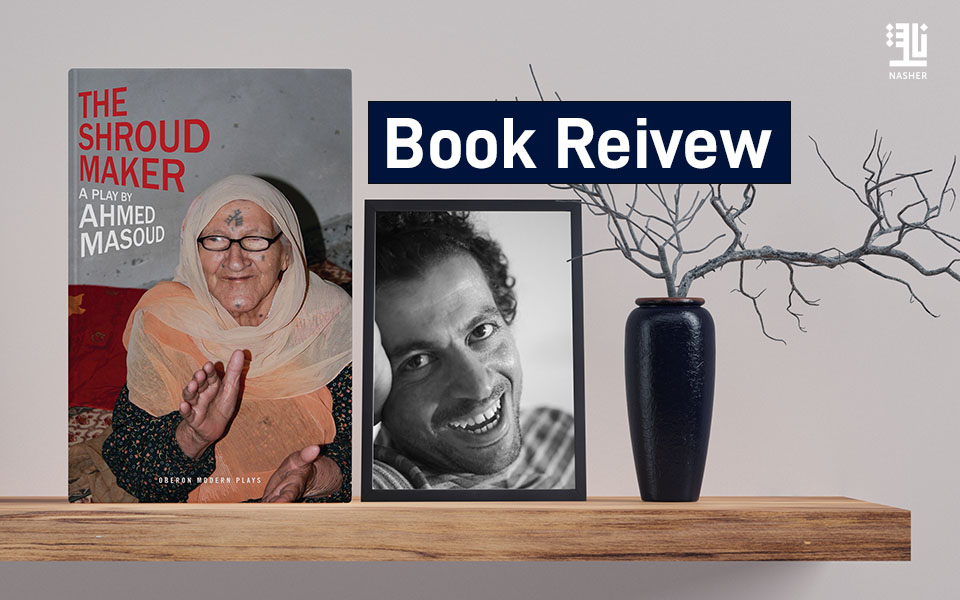
Publishing house: Oberon Books
“The Shroud Maker” play by author and director Ahmed Masoud tells the story of an 84-year-old woman who sells shrouds for the dead in order to survive. It’s a black comedy on the current situation, trying to highlight the humanity of the people, the sense of humour, and the great instinct of survival that a lot of people around the world have.
The protagonist, Hajja Souad grew up as the adopted daughter of the British high commissioner’s wife, Lady Cunningham. After the Nakba of 1948, she was left alone in the big mansion. As she managed to escape, she found an infant on the side of the Hebron road whom she adopts as her son.
She then moves to the West Bank and becomes a refugee until the October war when she finds herself again forced to flee to Gaza with her son. Elian, her son, then gets married and has a son. Elian gets killed in the first Intifada while Israeli soldiers arrest his wife.
Her Grandson, Ghassan, runs away to the other side of the fence and goes to live with an Arab Druze family who shelter him and later gets him to grow up as an Israeli. He joins the army and leads an incursion on Shujaia to destroy the tunnels, where Hajja Souad is based.
It is a monologue play where all the characters are played by one character, which is quite a gamble as it is a daring and bold decision is to play on the strong Arabic tradition of storytelling; it is the same as having a Hakawati (storyteller on stage) who takes the audience on a journey using mostly text but also some props and a lot of sound effects to transport them to an imaginative place.
A Palestinian from Gaza, Masoud came to the UK in 2002 to complete his postgraduate studies in English literature. During this period he wrote his first novel “Vanished – They Mysterious Disappearance of Mustafa Ouda”. In 2005, he started the Al Zaytouna Dance Theatre where he wrote and directed many dance productions including an adaptation of Ghassan Kanafani’s famous novel “Returning to Haifa”. But it was during the war on Gaza in July 2014, that the idea of “The Shroud Maker” was born.
Although the character of Hajja Souad is based on a real person but “the story is very different,” according to Masoud, and that it is “dark enough to provide both comedy and deep trauma”.
There is a mixture of comical yet painful words that brings a unique balance of heartache and laughter to the dark satire of Masoud’s script, and the readers are left with tears in their eyes even as they try to laugh grimly to Hajja’s no-nonsense attitude.
The readers connect with Souad, who is portrayed as a “real human being” with flaws as she shrewdly profits from people’s misery by overcharging people for shrouds.
“Well, what’s the alternative? Tell ’em the truth? “That’ll be ten shekels, madam. That’s right, ten shekels, I know, ever so cheap, isn’t it? Well, that’s ‘cos it’s made of polyester, yes, five shekels a roll from Yazji’s Superstore, yes, ‘fraid so, ‘ cos there’s no muslin left. All stocks exhausted, demand being so high, you know. Well, yes, if I’d known in advance I could have ordered extra supplies from the tunnel traders, but on this occasion, I’m afraid the Israelis neglected to inform me of their plans,” she tells the audience.
This mixture of comical yet painful words bring a unique balance of heartache and laughter to the dark satire of Masoud’s script, and the audience is left with tears in their eyes even as they try to laugh at Souad’s attitude
As her son, Elian grows, he married and has children of his own. Living under occupation they too suffer the effects of the First Intifada and their children are forced to run away for safety, a life that leads them to join the Israeli army and come back to Gaza to fight the Palestinians.
But even with the harsh truth of the attacks by Israeli soldiers on Palestinians in Gaza, it is not lost on viewers that all the misery helps Souad maintain her business, “kill everyone in this town and I will make shrouds for them all”, she tells the soldier. “I’ll give you 10 percent.”