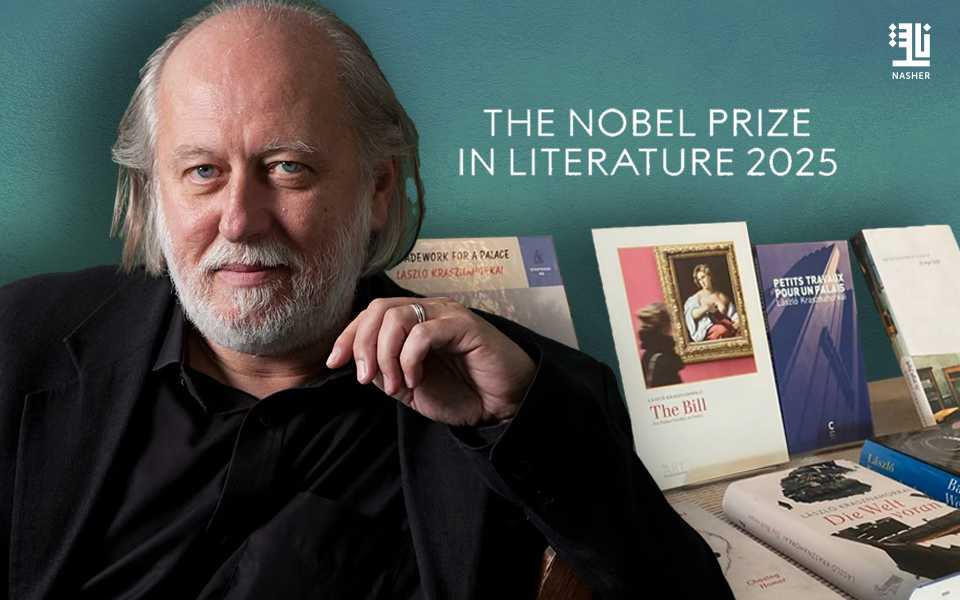
The Swedish Academy has announced Hungarian novelist László Krasznahorkai as the winner of the 2025 Nobel Prize in Literature, honoring him “for his profound creativity and his ability to kindle light in the darkest of moments.” The writer, famed for his long, labyrinthine sentences steeped in philosophical reflection and dark irony, returns to the global stage as a literary voice that sees in ruin a mirror of human frailty, and in imagination, a possible redemption. With this recognition, Krasznahorkai becomes the first Hungarian laureate since Imre Kertész in 2002. The prizes will be awarded, as tradition dictates, on 10 December in Stockholm, and the laureate will receive 11 million Swedish kronor, a gold medal, and a diploma.
This international recognition did not come by chance. The author of Satantango, The Melancholy of Resistance, and War and War has built a narrative universe that stretches reality to the edge of delirium, inspiring filmmaker Béla Tarr to adapt his novels into cinematic milestones of slow cinema. Krasznahorkai previously received the Man Booker International Prize in 2015 and the U.S. National Book Award for Translated Literature in 2019 for Baron Wenckheim’s Homecoming, cementing his place as one of Europe’s most distinctive contemporary voices. His Nobel triumph is also a celebration of translation, the bridge that has carried his complex Hungarian prose to readers around the world.
Krasznahorkai’s win revives an essential question about literature in times of turmoil: how can language retain its power to redeem when reality weighs so heavily on the spirit? The Academy’s citation gestures toward an answer: art, when guided by sensitivity and awareness, remains a force against erasure, binding humanity to its deeper meaning and granting it the courage to look ahead. Thus, this honor is more than an award; it is an affirmation of a literary vision that finds, even amid the world’s fractures, a seed of beauty waiting to grow, and of a writing that leads readers to the threshold where ruin and hope converge.
Hungarian novelist awins the 2025 Nobel Prize in Literature
The Swedish Academy has announced Hungarian novelist László Krasznahorkai as the winner of the 2025 Nobel Prize in Literature, honoring him “for his profound creativity and his ability to kindle light in the darkest of moments.” The writer, famed for his long, labyrinthine sentences steeped in philosophical reflection and dark irony, returns to the global stage as a literary voice that sees in ruin a mirror of human frailty, and in imagination, a possible redemption. With this recognition, Krasznahorkai becomes the first Hungarian laureate since Imre Kertész in 2002. The prizes will be awarded, as tradition dictates, on 10 December in Stockholm, and the laureate will receive 11 million Swedish kronor, a gold medal, and a diploma.
This international recognition did not come by chance. The author of Satantango, The Melancholy of Resistance, and War and War has built a narrative universe that stretches reality to the edge of delirium, inspiring filmmaker Béla Tarr to adapt his novels into cinematic milestones of slow cinema. Krasznahorkai previously received the Man Booker International Prize in 2015 and the U.S. National Book Award for Translated Literature in 2019 for Baron Wenckheim’s Homecoming, cementing his place as one of Europe’s most distinctive contemporary voices. His Nobel triumph is also a celebration of translation, the bridge that has carried his complex Hungarian prose to readers around the world.
Krasznahorkai’s win revives an essential question about literature in times of turmoil: how can language retain its power to redeem when reality weighs so heavily on the spirit? The Academy’s citation gestures toward an answer: art, when guided by sensitivity and awareness, remains a force against erasure, binding humanity to its deeper meaning and granting it the courage to look ahead. Thus, this honor is more than an award; it is an affirmation of a literary vision that finds, even amid the world’s fractures, a seed of beauty waiting to grow, and of a writing that leads readers to the threshold where ruin and hope converge.