
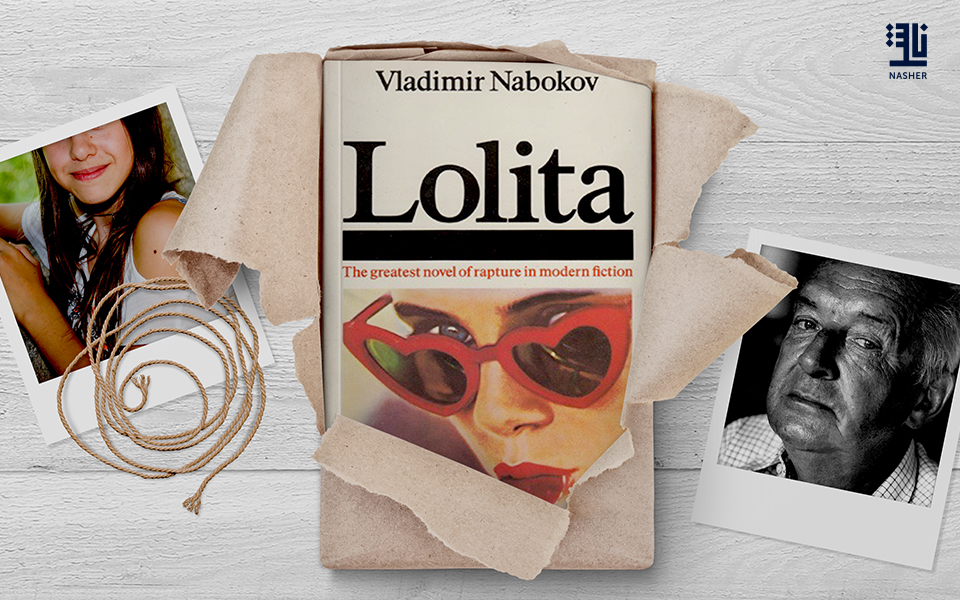
Lolita by Vladimir Nabokov is the story of a man’s obsession with a 12-year-old girl, the novel had been rejected by several publishers before G.P. Putnam’s Sons accepted it and soon became a bestseller that allowed Nabokov to retire from his career as college professor.
Nabokov declared once that he first had thoughts of Lolita in 1939 or early 1940 when he was living in Paris, he sat down to write his first extended treatment of the Lolita plot: an adult man marries a widow in order to gain access to the widow’s young daughter.
Finding a publisher for his novel was a challenge, Nabokov feared for his teaching position at Cornell, he initially explored the idea of publishing the novel under a pseudonym, but the publishers he contacted discouraged this idea. Nor were they themselves willing to undertake the risk of publishing what would surely be seen as a controversial work. Nabokov approached five American publishers — Viking Press; Simon and Schuster; New Directions; Farrar, Straus and Young; and Doubleday — but all turned him down; several were fearful of the complications that would ensue if the book were to be banned at its release. Nabokov also contacted an agent in France, to see if she might be able to find a publisher there, and she had better luck. In April 1955 Maurice Girodias, the owner of Olympia Press, was happy to take on Nabokov’s project. Nabokov signed a contract with Girodias in June 1955, and the book appeared in two paperback volumes of that year.
Lolita was named one of the best books of 1955 in the Christmas edition of London Sunday Times. This declaration led others to look for a copy of the book, and one critic was shocked by Lolita describing it as “the filthiest book” he had ever read and declared that anyone who published the novel in England would surely go to prison, and he scolded the Sunday Times for “stepping into the business” of publicising pornography.
The controversy brewing in Britain raised the interest of the American reader, and in 1956, the first American review of the novel was positive and as interest in Lolita was on the increase, Nabokov’s supporters in the States saw an opportunity to begin a campaign to publish the novel.
At the urging of the British government, which was disturbed by the prospect of its citizens bringing home pornographic material from France, the French government had decided in December 1956 to ban two dozen Olympia Press titles, with Lolita among them.
Hopes for publishing Lolita in America continued to rise during this period, but Nabokov now found himself embroiled in a dispute with Girodias over the rights to publish the novel in the United States. Increasingly frustrated with the demands and evasions of his French publisher, Nabokov was happy to let Walter Minton of G. P. Putnam’s Sons negotiate on his behalf. Eventually they came to an agreement, and in March 1958 Nabokov at last signed a contract with Putnam’s to publish Lolita later in the year.
The publication of Lolita on August 18, 1958 was accompanied by a host of reviews. Most were positive, but one, by Orville Prescott, called the book both “dull, dull, dull” and “highbrow pornography.” Within three days, the novel was into its third printing with 62500 copies in print, and within the first month, the novel had sold over 100000 copies. By the end of September Lolita was at the top of the best seller list where it remained for seven weeks until it was displaced by Boris Pasternak’s recently released Doctor Zhivago.
A movie deal for $150000 was soon signed, and deals to translate the novel into numerous languages followed apace. It would take another year for the novel to be released in Great Britain.
Nabokov was born in 1899 in St. Petersburg, Russia, into a wealthy and privileged family. He grew up speaking both English and Russian, attended Cambridge, and inherited $2 million from an uncle. However, his family lost much of their wealth when the Russian Revolution forced them to flee to Germany. Nabokov earned money by teaching boxing and tennis, and creating Russian crossword puzzles. He worked during the day and wrote at night, sometimes in the bathroom so the light wouldn’t bother his family. He wrote many novels and short stories in Russian. In 1939, the tall, athletic scholar was invited to Stanford to lecture on Slavic languages. He stayed in the U.S. for 20 years, teaching at Wellesley and Cornell, and pursuing an avid interest in butterflies.
His most successful books in the U.S. were Lolita and Ada (1969), a family chronicle about a childhood romance between two close relations, which becomes a lifelong obsession between the characters. Nabokov and his wife returned to Europe in 1959, and he died in Switzerland in 1977.