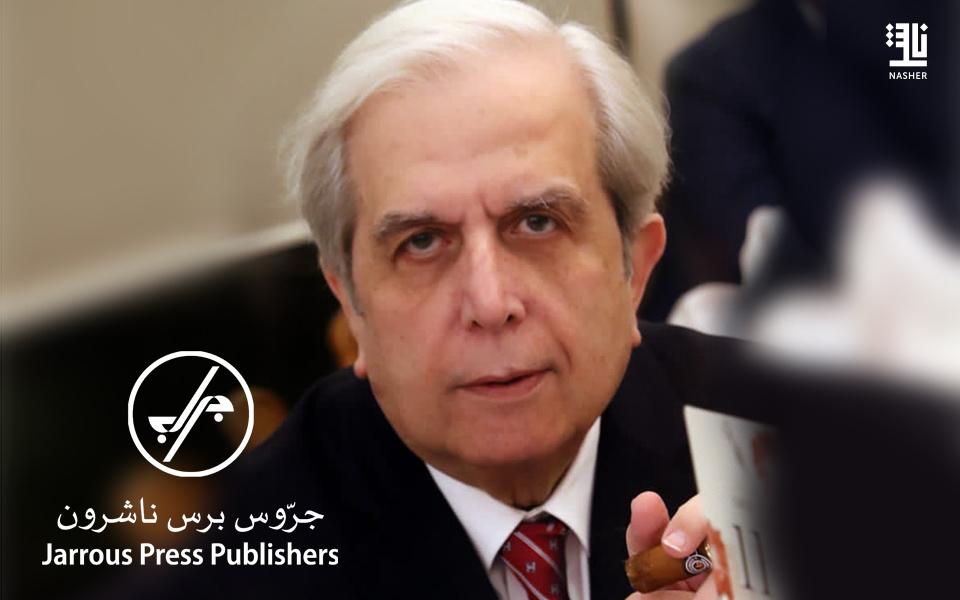
One of the best-known faces in international publishing, the Lebanese publisher Nasser Jarrous, is writing his memoirs. The book will be published in January, first in Arabic and then English, by his own company, Jarrous Press, based in Tripoli. It will be his chance to set down what he has learned in more than 40 years in the business.
“I am writing this book for my children, to show them that life is not easy and nothing is fixed,” he says. “I want to tell them that there are difficulties and pitfalls, but with strong will, love and solidarity we can come through. Do not give up – learn from your mistakes because they are part of your path to success.
Jarrous has for many years acted as a kind of cultural ambassador between east and west, smoothing the way for western publishers to do business with Arab countries, making introductions and facilitating western publishers’ participation in books fairs in the region, notably in the more closed markets like Saudi Arabia. It is a role for which he seems born, with his natural bonhomie, language skills (Arabic, English and French) and genuine desire for people to engage in dialogue. He likes bringing people together.
However, his memoirs do not shy away from criticism of Arab publishing which he describes as “weak and in need of modernisation and development”. He continues: “The majority of Arab publishers are held back from developing because of a lack of financial resources, as well as weak markets which have been made worse by the cancellation of book fairs and the closure of libraries due to COVID-19. With the exception of the United Arab Emirates – and particularly Sharjah – which supports writers and authors, Arab countries are absent from extending a helping hand to the publishing sector. If the situation remains the same, there is no future for the publishing sector, and many publishing houses are going to close.”
He notes that Arab publishing houses suffer from “the crisis of piracy and freedom of expression which limits creativity and the easy transfer of Arab books between countries”. He adds: “The overwhelming majority of Arab publishing houses have not been established in a professional and scientific manner, and many publishers lack experience and knowledge on how to face the crises that hinder the publishing industry. This is why, during my dealings with international book fairs, I insisted that there should be a training element for Arab publishers.
“International cultural institutions like the British Council in London and the Goethe Institute in Germany, and many others, should redouble their efforts to introduce the cultures and manners of different countries in order to strengthen cooperation in the fields of publishing”
Initially trained as a lawyer, Jarrous joined his father’s books and magazine distribution business in 1978 and soon added book publishing to the firm’s portfolio. He became a member of the Board of Directors of the Syndicate of Publishers Union in Lebanon in 1990 and in cooperation with the Syndicate, launched the Lebanon International Book Fair and held its presidency for a period of 7 years until 2001.
It was through this role with the Publishers Union in Lebanon that his international career developed. In 2000 he smoothed the way for the Arab World to be Guest of Honor at Frankfurt which led to a more formal arrangement with exhibition-owners Reed in 2006, with a particular focus on providing links between US publishers and the Arab world for the Reed-owned London Book Fair and Book Expo America. He recalls: “I developed business relations with Frankfurt, London and USA. These relations opened the way for the international book publishing industry to enter our Arab world. In return, Arab publishers benefited from international experience. It was a period full of developments, achievements and fruitful cooperation, which I have covered in my book.”
In recent weeks, he has been saddened by Reed’s decision to cancel BookExpo. He worries that there isn’t the political support for the books business in the US. “I don’t think in the US there is governmental interest in supporting the publishing industry. There should be an association which supports books and writers like the British Council and Goethe institute and which are expanded around the world. I think the US has become closed in on itself.”
Along with many in the industry, he hopes that the new administration under President Biden may view the book industry more positively.
His memoirs have given him the chance to thank the many friends he has made in the industry. “In the book I have thanked those who supported me and from whose knowledge I have benefited. I am honored and proud to have the friends I have made in this business over the years. Do not stop giving and helping others – I was happy when I was serving and helping others, or serving my country, my surroundings and my profession. I did not hate people who offended me – I simply changed my behavior with them. For me, working was a pleasure and a passion…
His daughters Rania and Noor, and son Adib, also help in the business and have become familiar faces at international book fairs before the pandemic. Appropriately, he saves his final words for the institution of family.
“It is the family that is the cornerstone, so let us preserve it. Family is the support and help that stands by our side in the most difficult circumstances – and that has been the case this year perhaps more than any other.”