Though perhaps not as important as re-joining the Paris Climate Accords or establishing a Covid task force, someone in president-elect Joe Biden’s team must nevertheless be planning the new president’s inauguration on 20 January 2021.
The task highlights one of the oddities of American politics. Five poets have read or recited poems at US presidential inaugurations – and they have all been for Democrat presidents.
Wispy, white-haired Robert Frost was the first, at John F Kennedy’s inauguration in 1961, and the Democrat link with poetry continued through Bill Clinton (twice) and Barack Obama (also twice).
None of the Republicans in the in between years sought help from poets, though the former librarian and teacher Laura Bush did host a celebration of American authors on the eve of her husband George W Bush’s inauguration in 2001. Guests included Mary Higgins Clark, the historian Stephen Ambrose and the celebrated jazz critic Stanley Crouch.
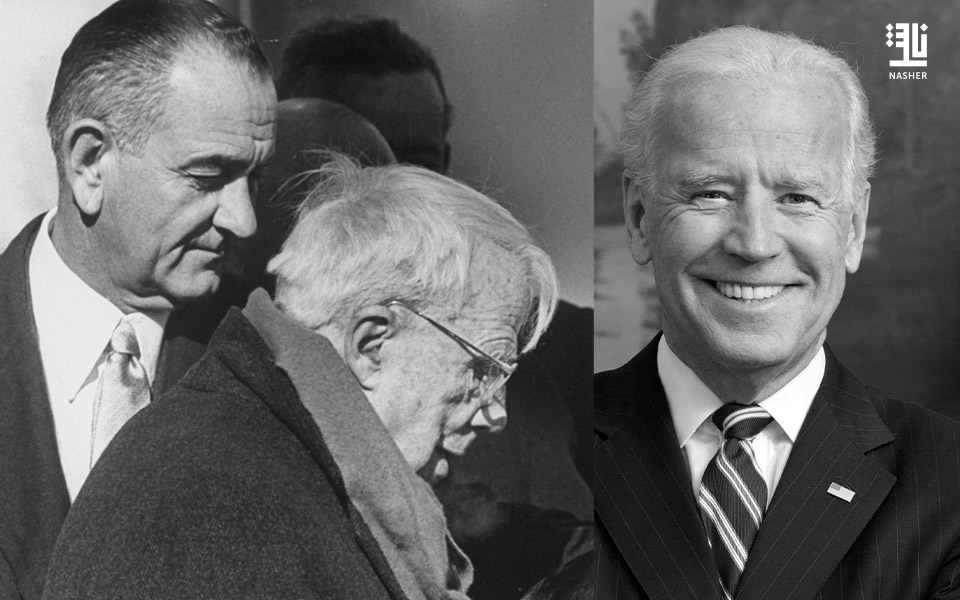
It was on the 20 January 1961 that the tradition of including a poet began, if it can be called a tradition. On that bitterly cold day, Robert Frost recited from memory his poem ‘The Gift Outright’, a special request from the new President, JFK. In fact, Frost had famously written another poem – ‘Dedication’ – for the occasion. But when he stepped up to the podium a combination of the bright sunshine, blustery conditions and the faintness of the print, meant that he had difficulty reading the words. He was almost 87 and frail and clearly struggling.
In scenes that look comical in the black and white footage of the occasion, vice president Lyndon B Johnson puts his hat over the fluttering papers to provide shade, but to no avail. There is nervous laughter and then the country’s unofficial poet laureate seizes the moment and recites the much-loved ‘The Gift Outright’, making one change at Kennedy’s earlier request. He substitutes ‘will’ for ‘would’ in the last line:
‘To the land vaguely realizing westward,
But still unstoried, artless, unenhanced,
Such as she was, such as she will become.’
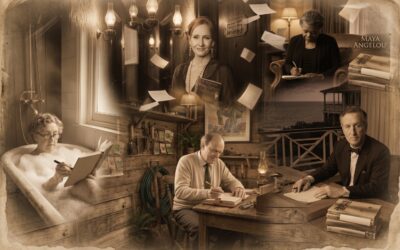
In 1993, Maya Angelou read ‘On the Pulse of Morning’ at Bill Clinton’s first inauguration, which was published in a special edition by Random House. At Clinton’s second inauguration, in 1997, Clinton’s long-standing Arkansas friend Miller Williams, who died in 2015, read ‘Of History and Hope’. Next came the young, Harlem-born poet Elizabeth Alexander who read ‘Praise Song for the Day’ at Barack Obama’s first inauguration in 2009. It has this lovely ending:
‘In today’s sharp sparkle, this winter air,
any thing can be made, any sentence begun.
On the brink, on the brim, on the cusp,
praise song for walking forward in that light.’
At Obama’s second inauguration, in 2013, Richard Blanco became the first Latino and first openly gay poet to read at a presidential inauguration. His poem ‘One Today’ has a powerful opening, as if we are soaring above the land.
‘One sun rose on us today, kindled over our shores,
peeking over the Smokies, greeting the faces
of the Great Lakes, spread simple truth
across the Great Plains, then charging across the Rockies.’
It seems likely that Biden will pick a poet, or at least that poetry will form part of the occasion. Poetry arguably means more to Biden than to any of his predecessors. He has talked about reciting Yeats as a youngster to cure his stammer, and he is very fond of quoting Seamus Heaney, in particular this verse from Heaney’s interpretation of Sophocles’ Philoctetes, The Cure at Troy, published by Faber.
‘History says, Don’t hope
On this side of the grave,
But then, once in a lifetime
The longed-for tidal wave
Of justice can rise up
And hope and history rhyme.’
He quoted these lines in his campaign video, a highly literary reference that left the current President without a twitter response (though one can imagine Trump bashing out: ‘Seamus WHO? Sleepy Joe has dug up some quarterback no one has heard of. So sad, so sad.’)
Does the fact that all these poets read at inaugurations of Democrat presidents mean they were – or are – Democrats themselves? Angelou was for sure; so too Miller Williams, who campaigned for Clinton. We can assume Elizabeth Alexander is, since she is a friend of Obama’s from the University of Chicago, where they were both on the staff. Her parents were both active in the civil rights movement and held her, aged one, to hear Martin Luther King’s famous ‘I have a dream’ speech.
It seems highly unlikely that Blanco is a Republican. He is, after all, a founding member of the Obama Foundation Advisory Council. Which just leaves that American icon, Robert Frost. At first, one assumes he must have been a Democrat; after all, Kennedy, used to end his campaign speeches by thanking those who had come and then quoting Frost, from ‘Stopping by Woods’, about having ‘miles to go before I sleep’.
But dig around a little and it’s not so clear. Jay Parini in Robert Frost A Life notes that Frost was not a fan of the New Deal of the thirties – the social security measures brought in by the Democrat president, Roosevelt: ‘[Frost] maintained his anti-New Deal conservatism to the end,’, writes Parini, ‘believing it was better for one to provide for oneself and one’s family than to have the state do it. He hated the notion of the collective, of the masses.”
He also hated any ‘ism’, apparently, preferring to think of himself as a “lone striker” and expressing a loathing for socialism, communism, anarchism and even humanism, according to Parini. He was more akin to a libertarian.
It would be foolish to conclude from the inaugurations of just three presidents that only Democrats have a poetic sensibility, and it is worth noting that it was Ronald Reagan’s administration that created the position of US Poet Laureate in 1985.
In 2017, the year Trump became President, the San Francisco poet and author Dean Rader at first said he would not read at the inauguration, but later told the Washington Post: “I think we have an obligation as artists to insert our voice into the larger conversation about our country and our culture. At some level, the inauguration of a president is an affirmation of democracy. On a larger scale, it’s not even about a particular person, but about an ideal – a philosophical project.” As it turned out, the call didn’t come and no poet spoke at Trump’s inauguration.
So it will interesting to see who Biden picks. Who will he choose to mark the historic handover of power? Who will he choose to voice a phrase that enters the national consciousness? Who will seize the moment and try, on that world stage, to make us all believe that, to quote Heaney again, ‘a further shore is reachable from here’?