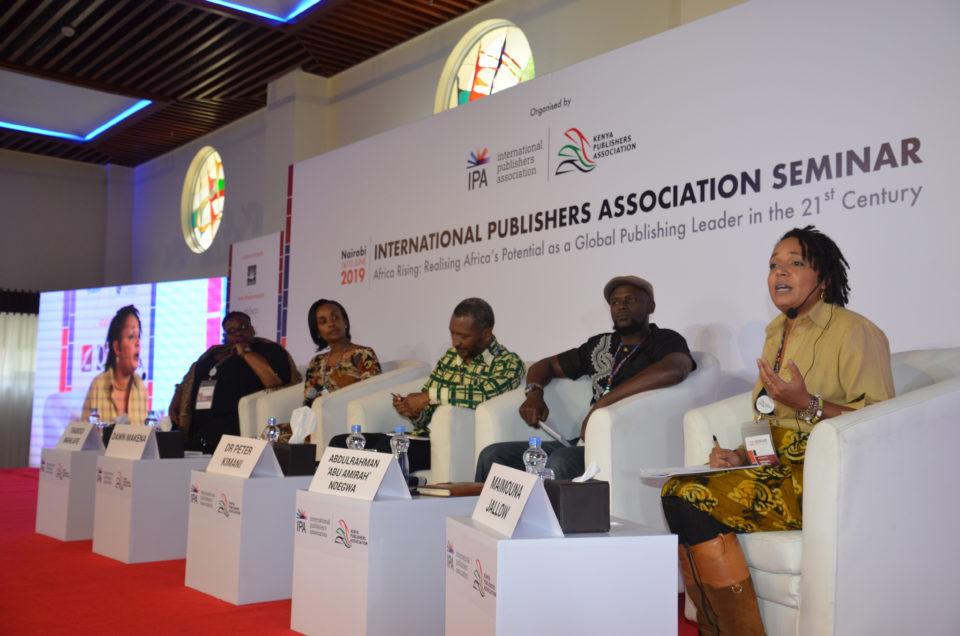
Kenyan Novelist Peter Kimani, whose Dance of the Jacaranda was a New York Times Notable Book, criticised African publishers for not showing the support that he has received from international publishers. “The rest of world was applauding my efforts, but not so in my own town,” he said at the panel on Developing Africa’s Next Generation of Publishers, Writers and Artists chaired by writer and journalist Maimouna Jallow. “How can an American publisher see the potential first and not a Kenyan publisher?”
He added: “Who is telling Africa’s story? New York publishers? London publishers? It is very frustrating. The Arabic edition is coming – some countries do see the possibilities, they see an opportunity. Professor Thiong’s [who spoke in the morning] said we must invest, nurture and harvest. My US publisher is going into a fourth printing with a big chunk of copies coming to Kenya.”
He told Publishing Perspectives earlier in the month that African publishers had no imagination, but Thabiso Mahlape, publisher of South Africa’s BlackBird books jumped to their defence. “It’s very difficult to publish on this continent. We do our best. We ought to look at things holistically before we say that [publishers have no imagination]. The publishing system belongs to all of us.”
Mahlape talked about how important it was to have black people in prominent positions in publishing. “The narrative is black people don’t read, but the second book I published – My father my monster – which was real, black South African experience, did very well and turned South African publishing on its head.
“I used to think that books were an overseas thing. But this is all about instilling confidence. Our white counterparts don’t need the confidence. Young black people need someone to say ‘I see you’.”
At the session on self-censorship, there were interesting remarks from Dr Tom Odhiambo, Lecturer of Literature at the University of Nairobi. He said that it wasn’t so much “top down, coming from governments”, as being driven by ordinary citizens. “We need to ask where does censorship begin? When we published a book of stories about gay Kenyan men and women we were more afraid of our fellow Kenyans than we were of the government. I have people in my classroom who will ask why such books are published, talking about ‘literary purity’.”
His fellow panellist Dawn Makena, CEO of Storymojo Africa, said publishers should be pragmatic and form alliances to combat government interference, and Sihem Bensedrine, president of the Truth and Dignity Commission of Tunisia, observed poignantly: “Each book censored is part of our memory lost.”