Originally published: October 15, 2020
Publishers: Hashtag Press
Genre: Domestic Fiction
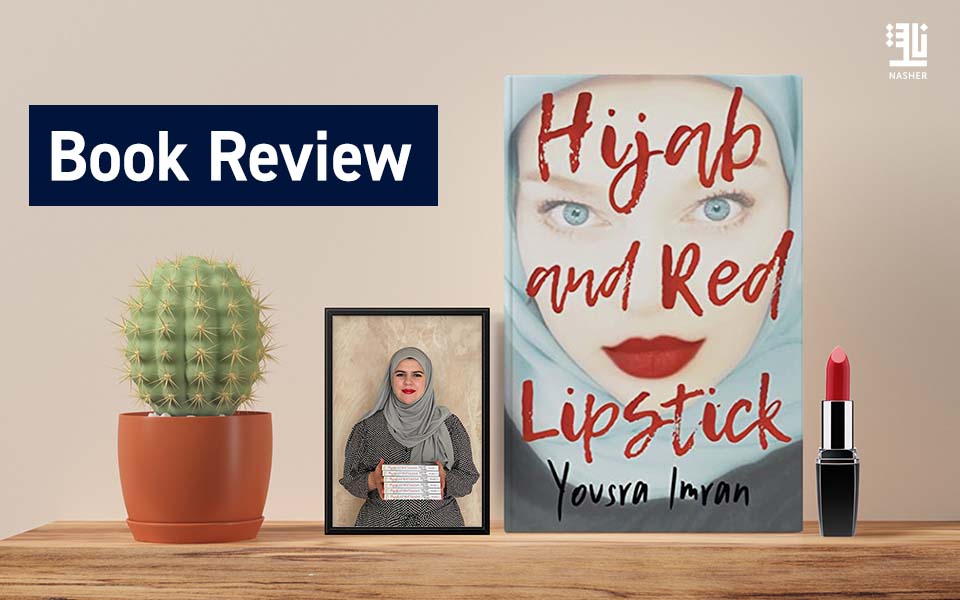
Hijab and Red Lipstick is Yousra Imran’s debut novel explores more than one social issue all through the voice of Sara, whom we accompany on her journey from a child in London to young adulthood in Qatar.
Sara, a half-English and half-Egyptian girl is torn between her ethnicity, identity as well as wanting to please her strict father while simultaneously being her self and enjoying the life she wants to live.
The story starts with Sara walking to meet Sophie, a BBC journalist, at a central London café. Despite feeling uneasy, she begins to discuss her life experiences. With Sophie, the reader embarks on Sara’s journey which is full of internal struggles. Being of a mixed race has its own challenges but to suddenly up-root your life from a country you identify as ‘home’ to a different, more conservative and patriarchal country is a difficult transition let alone for a young girl who is aware of her father’s mood swings and the influence that his male friends have on him which ultimately will impact Sara, her mother and siblings.
We the reader, share Sara’s excitement when she finally manages to go to her friend’s birthday party, we share her vulnerability when she first falls in love and we experience her horror when she physically violated yet can’t speak about her ordeal.
The book grabs your focus from the first page and ironically just like Sara’s double life, the book too has a double, contradictory type of element, as it is an essentially an easy read yet at the same time it is a difficult read especially when Saffa is sexually assaulted and Sara is raped. Despite getting to know her family extensively, the book was exclusively told through Sara’s eyes in the chronology of her own life.
In Hijab and Red Lipstick we get to know Sara’s family without really knowing them, their presence in the book essentially serves the purpose of how they affected Sara. From her brothers’ conservative phases, to her sister’s rebellion, to her mother enabling her father’s abuse by not standing up to him, we didn’t learn anything about them, their struggles, the reason behind their behaviour, everything we learnt about them was from Sara’s view, making all the characters one dimensional as everything was blamed on the father, a firm belief of Sara. It would have made the book more interesting had we got to know the father and find out why he behaved in such a way, why was he weak around the influence of his friends and so domineering within his immediate family?
Most of the men in the book are abusers, which can be a problematic feature of Hijab and Red Lipstick, was it a generalisation and stereotype by the author or did she really meet these types of men in real life? By identifying her brother, Abdullah’s friends as Palestinians is a generalisations and readers will assume all Palestinian men physically beat their mothers and sisters which is a rather uncomfortable assumption.
Although the ending has a liberated and defiant outcome but its also a slight let down as it felt rushed or it came to an abrupt end that saw Sara move out of her family home and we are told on the next page that she is living in London, without an explanation of how and why she left Qatar.
We have given it 3/5 rating