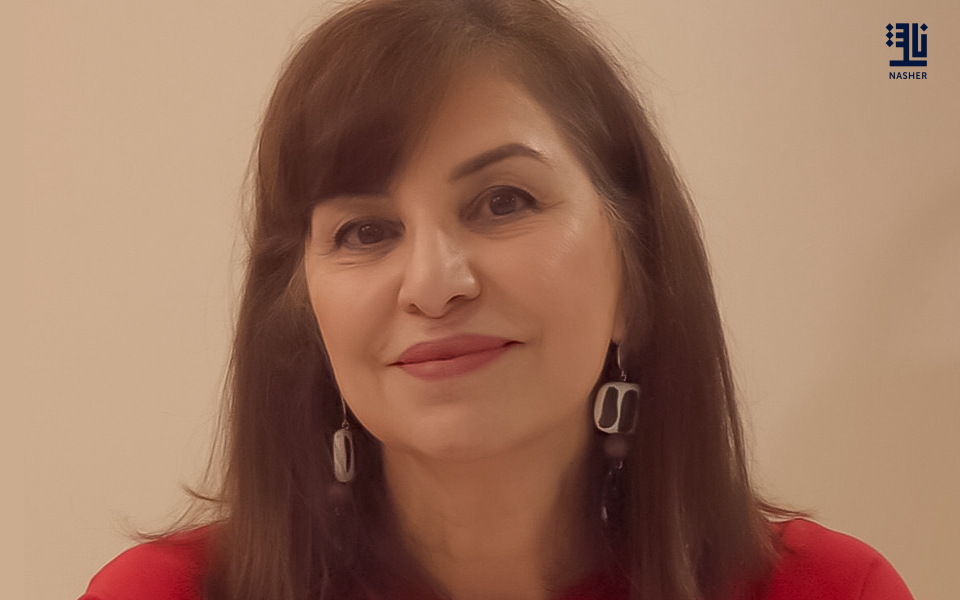
Iraqi translator Hend Saeed, cultural advisor, and literary consultant, hosts a weekly cultural and literary program on YouTube under the title “Book Conversation”, which aims not only to promote reading, but also to raise the passion for creativity and culture among the listener and viewer. Hend has succeeded in hosting a group of writers and poets during the last period, and presented many books and novels.
In this interview with “Nasher”, Hend highlights the impact of the Covid-19 pandemic and social media on reading, and the concept of her program “Book Conversation”. She also sheds light on various aspects of her experience in dealing with authors and publishers, and how she see the future of reading and the book industry in the Arab world.
* Can anyone become a writer by training, even if he lacks the talent to write?
A person can become a writer of articles or an author of studies or research if he is well trained to do so, but he cannot be a novelist if he does not have the talent. I believe that the talent of writing requires an ability to reflect ideas on paper, and to have a broad imagination, creativity and full awareness of real life’s challenges.
* What are the characteristics of a good writer? And what does a writer need to practice writing as a continuous daily habit?
Certainly there are some practices that everyone who wants to be a writer must do, which is daily writing. This may include writing daily events, reading and learning, general knowledge, and life experiences. I believe a writer should find out his weaknesses that may prevent him from writing, and learn how to get rid of them.
* As a literary agent, why are many Arab writers not interested in having a literary agent promoting their work?
Perhaps the term ‘literary agent’ is still incomprehensible to many in our Arab world. Some writers, including those who have no published works yet, have resorted to me to present their works to publishers. As a literary agent, my job is to read the book and make some comments on it. I might suggest some changes or revisions before it is presented to the publisher. However, some still do not accept positive criticism, and rather get angry when I make any comments on their writings!
* It is said that the Covid-19 has increased the interest of publishing houses in translation and translated literature, what do you think? And why?
The publishing industry has witnessed a remarkable change in terms of translations and the transfer of cultures, perhaps because the whole world was experiencing the same challenge posed by the pandemic, so there was a common bond for all of us around the world. Indeed, there is an increasing demand from Arab readers towards translated books, as well as a remarkable interest by a number of Arab publishers in re-translating old and classic books. On the other hand, Western publishing houses are open to Arabic books, especially children’s publications, perhaps out of a desire to spread tolerance, love and non-discrimination among children.
* Let’s talk about your “Book Dialogue” Program, what is its concept, and what makes it different from other programs available on social media?
During my previous role as Director of the Arabic Program at the Emirates Airline Festival of Literature, as well as my current job, I read a lot of books that I found many of them to be good, but not on the right track, causing reader to miss them out. Therefore, I decided to present a weekly 30-minutes program every Saturday morning. Through the program, readers can get to know the book through the author himself, and they have the choice to read it or not.
* How do you see the future of reading in the Arab world? What should governments and institutions do to increase interest in the book?
I think the future of reading in the Arab world has begun to mature properly, albeit slowly and on a very small scale. There are readers who are still looking for a book to read, as reading is part of their daily life. But for the majority, reading is still a passing thing in their life.
As for how institutions can support writers, the beginning should be from combating book piracy, and increasing interest in revision, auditing and book review. The presence of programs that help writers develop their skills and devote themselves to writing is also important to support the book industry in general.