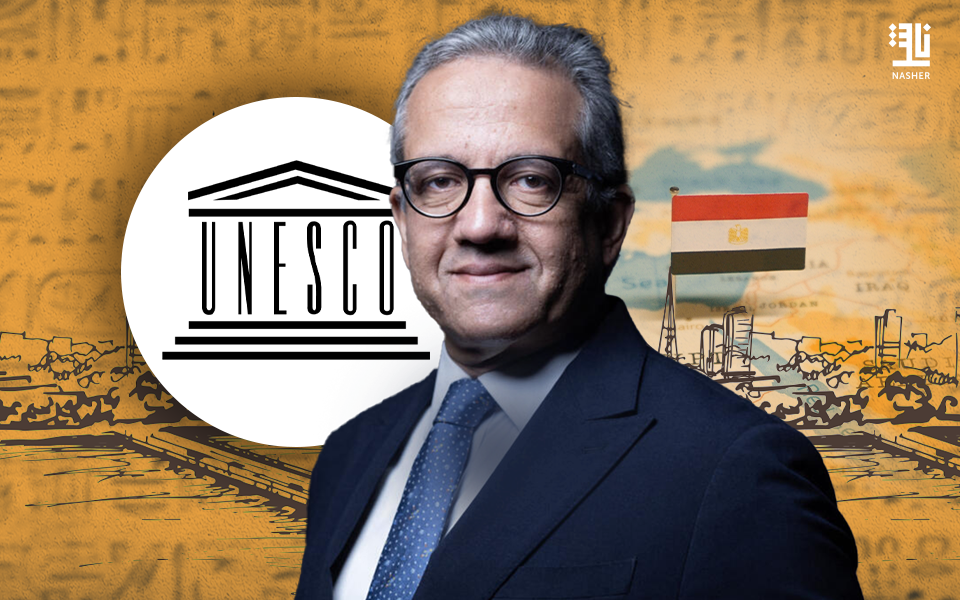
In a historic moment that adds a new chapter to the Arab world’s cultural legacy on the global stage, Dr. Khaled El-Enany has been elected Director-General of the United Nations Educational, Scientific and Cultural Organization (UNESCO), becoming the first Arab ever to hold this position since the organization’s founding in 1945. His election, by an overwhelming majority of 55 votes to 2 in Paris, marked a rare moment of international consensus around a figure who embodies both academic depth and administrative vision. With this choice, UNESCO opens a new era defined by leadership diversity and a renewed connection with the Arab world.
El-Enany’s appointment crowns a distinguished academic and cultural journey that began with his tenure as a professor of Egyptology at Helwan University. He later directed the National Museum of Egyptian Civilization before assuming the roles of Minister of Antiquities and subsequently Minister of Tourism and Antiquities. Throughout his career, he has been celebrated for linking culture with development and for leading major restoration projects that revitalized Egypt’s museums after years of challenges. Representing his country at countless international forums, he consistently placed culture at the heart of dialogue among nations, paving the way for his candidacy with strong Arab and global support.
During his campaign, El-Enany advanced the slogan “UNESCO for the People,” emphasizing the need for the organization to reclaim its role as a unifying platform for knowledge, creativity, and cultural justice. His program focused on advancing education, protecting endangered heritage, and promoting freedom of artistic expression, while fostering greater partnerships with the private sector and independent cultural institutions. He also underscored the importance of a more geographically and culturally inclusive organization, one capable of responding to the digital and environmental transformations shaping humanity’s future.
His victory carries profound symbolic meaning for the Arab world, coming at a time of significant cultural transformation across the region, marked by increased investment in knowledge, education, and heritage preservation. The election of an Arab to lead UNESCO reflects the international community’s confidence in Arab intellectual leadership and reaffirms the region’s historic role in shaping humanity’s collective memory. It also signals the dawn of a new approach to global cultural governance, one grounded in dialogue, diversity, and shared humanity, rather than Western-centric paradigms of the past.
UNESCO now faces major challenges, from securing sustainable funding after the withdrawal of key contributors, to adapting to the disruptive rise of artificial intelligence and its impact on education and creativity. El-Enany is expected to lead a reform-driven agenda that balances authenticity with modernization, drawing on his extensive experience in steering cultural institutions through economic and political complexity. His official appointment, expected to be ratified at the General Conference in November, will mark the beginning of a new era for global cultural cooperation, one guided by an Arab vision that restores culture’s timeless role as a bridge between nations.