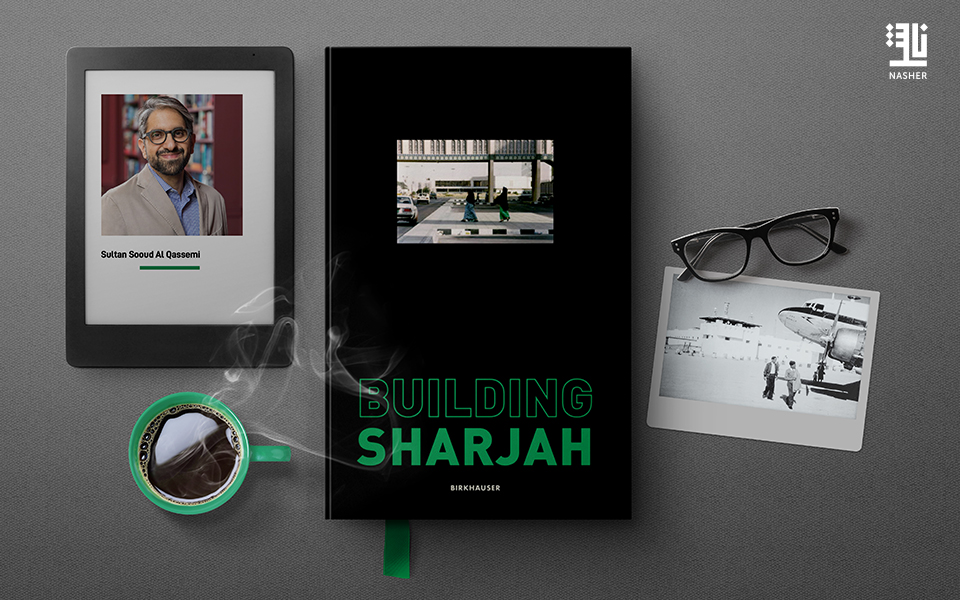
The extraordinary growth of Sharjah in the UAE – and a reminder of some of the city’s buildings and sights that have been lost in the process – are lovingly captured in a glorious coffee-table book from Swiss architecture publisher, Birkhauser.
Building Sharjah is co-authored by the Emirati columnist, researcher and founder of the Sharjah’s Barjeel Art Foundation, Sultan Sooud Al Qassemi, and the architect and writer Todd Reisz. Together they have looked through hundreds of photographs, many in evocative 1970s colour and others from the black-and-white years, provided by architects and engineers of the time, or sourced from family archives via social media. The book gives life to a forgotten city and emirate, one that is sometimes so busy rising up it can forget what is being torn down in the process. This book is a loving reminder on what has been.
Al Qassemi explains: “We sought to capture an era that once seemed enduring but now has proven fleeting. The story many know of Sharjah, like other cities made rich with oil, is that a mere fifty years separate mudbrick houses from today’s glass skyscrapers. What existed in the in-between? What structures did people of this land live in after they abandoned areesh, or palm frond huts, and mudbrick homes and before the advent of twenty-first-century glass and aluminium towers? Through this book, we attempt to construct a landscape as well as a context to consider these questions and more.”
He says their intention was not to write an encyclopaedic survey of the emirate but to “offer a chance to reconstruct a landscape of a city that, some ways, no longer exists and parts of which never did”.
Reisz became involved when he got to know Al Qassemi when Reisz was working on a series of titles cities of the Gulf, a series known as Al Manakh. “About five years ago, Sultan had started collecting evidence of Sharjah’s changing landscape, which includes the ongoing demolition of many of the important buildings of the city’s modernization,” he recalls. “He reached out to me about four years ago to propose working on a publication together. It was an easy yes from my side. I’m trained as an architect and had been focused on work on the Gulf since around 2005. At the time, I was just finishing up the manuscript of Showpiece City, an urban history of Dubai, so it felt like a nice way to continue learning and use the history I had built up.”
The title is being sold by UK sales agency Avicenna, the company that represents many academic publishers in the region and which was founded – and is still run – by Bill Kennedy, a Scotsman with a deep affection for, and knowledge of, the Arab World. Among bookstores and institutions stocking the title are Magrudy’s in Dubai, Sharjah’s Barjeel Art Foundation, Dubai’s Gulf Photo Plus and Jameel Arts Centre, also in Dubai. It has clearly struck a chord too, because it has gone into a reprint.
One of the loveliest of pictures is a double-page spread of the Sharjah Waiters’ Race, photographed in the Eighties, with the contestants each balancing trays of drinks and clearly enjoying themselves. It was the sort of occasion which led to the famous ‘Smile You are in Sharjah’ motto.
There are also pictures of the original Sharjah Air Station, once situated in the desert and now surrounded by the city (Sharjah’s busy King Abdul Aziz street is actually the former runway). For anyone who knows the city, the book is feast of nostalgia. If buildings could talk…well, in a sense they do in this book.
What are Al Qassemi’s conclusions and how does he see the future? “If there is a consistent theme in the stories of Sharjah, it is of a city that has given way to economic conditions and political affiliations: from mudbrick architecture, to the faintest advancements under British protectionism, to the Pan-Arab modernity of the 1950s and 1960s, to the oil boom of the 1970s, and finally the Islamic tide of the 1980s. The search for an identity has left behind an urban patchwork: traditional, modern, Islamic, and global all at once.”
He adds: “It would be an amazing testament to history, if only it could continue to exist.”