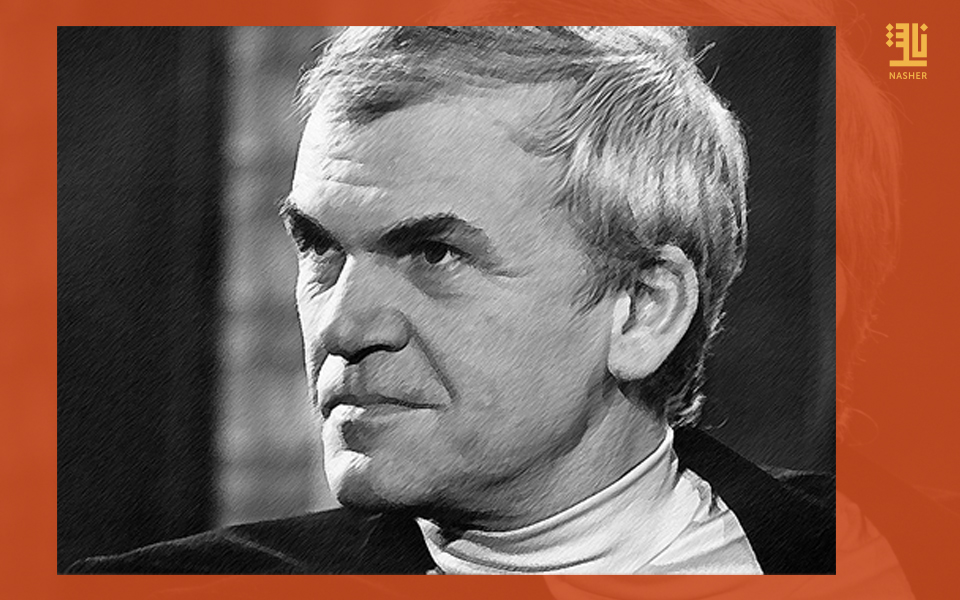
Milan Kundera, one of the biggest names in European literature in recent decades, has died in Paris aged 94.
His best-known work was his 1984 novel The Unbearable Lightness of Being.
Anna Mrazova, a spokeswoman for the Milan Kundera Library in his home city of Brno in the Czech Republic, said he had died after a long illness. Famously leaving his homeland for France in 1975 after earlier being expelled from the Czechoslovakian Communist party for anti-communist activities,
Kundera spent 40 years living in exile in Paris after his Czech citizenship was revoked in 1979. There he wrote his most famous works, including Nesnesitelná lehkost bytí (The Unbearable Lightness of Being) and later left behind his mother tongue to write novels in French, beginning with 1995s La Lenteur (Slowness) and his final novel, 2014s The Festival of Insignificance. He was often cited as a contender for the Nobel Prize in literature. Born in 1929 into an elite Czech family, his father was a piano teacher and a student of the composer Janacek, and ensured Kundera received musical training at an advanced level.
Kundera studied in Prague, becoming a lecturer in world literature. He joined the ruling Communist Party and initially he was an ardent member.
But his writing soon got him into political trouble. His first novel The Joke – a black comedy published in 1967 – led to a ban on his writing in Czechoslovakia.
In 1970 he was asked to leave the party after expressing support for the Prague Spring movement, the period of political liberalisation crushed by the 1968 Soviet invasion.
Kundera’s activism led to his dismissal from his teaching post and his novels were removed from public libraries, while the sale of his work was banned until the fall of the Communist government in 1989.
For a short time he performed as jazz trumpeter, before emigrating to France in 1975 with his wife Vera, settling first in Rennes then Paris. He became a naturalised French citizen in 1981, two years after he was stripped of his Czech nationality, and eventually wrote in French.
After losing hope that Czechoslovakia would ever reform, he moved to France in 1975, lost his Czech nationality in 1979 and became a French citizen in 1981. He soon secured a reputation as a ground-breaking author with The Unbearable Lightness of Being, which told the story of four Czech artists and intellectuals and a dog caught up in the brief period of reform that ended when Soviet tanks rolled into Prague.
The book was adapted for the screen in 1987, starring Juliette Binoche and Daniel Day-Lewis. But Kundera expressed dissatisfaction with the film and with what he perceived as a lack of acceptance of the novel in the modern world. It was eventually published in his homeland and became a bestseller there in 2006. Kundera always rejected the idea that his work was inspired by his own life experiences, a claim that was heavily scrutinized in 2008 when the Czech weekly?newspaper Respekt published an article accusing the acclaimed author of acting as a communist police informant in 1950.
Based on an investigation by the Czech Institute for the Study of Totalitarian Regimes, the story alleged that a police report from that year showed that Kundera, then a student dormitory leader, denounced a young ex-pilot who had defected after the communist coup and later returned as a Western agent. He was arrested and spent 14 years in labour camps.
Kundera, having spent more than two decades living in seclusion and declining to do interviews, took the unusual step of speaking up. He strongly denied the accusation, calling it the assassination of an author.
He was defended by many high-profile Czech and international writers, including; Salman Rushdie, JM Coetzee and the former Czech President and playwright Vaclav Havel. His 1979 work The Book of Laughter and Forgetting spanned seven narratives and containing elements of the magic realism genre, while in 1988 he wrote one of his best novels, Immortality.
In 1985 he received the Jerusalem Prize – a prize given to writers whose works have dealt with themes of human freedom in society.
And while he was a frequent contender for the Nobel Prize for literature, the award remained elusive.
A final brief novel, La festa dellinsignificanza (The Festival of Insignificance), appeared in Italian translation in 2013. It divided reviewers when it appeared in English, some praising its crisply elegant humour and others judging that it marked the end of a series of retreats into mere cleverness.
After 40 years away, apart from brief and low-key visits to their homeland, Kundera and his wife Veras Czech citizenship was finally restored in 2019, a year after they met with the Czech prime minister Andrej Babi, who described the meeting as a great honour. A year later, Petr Drulák, the Czech Republics ambassador to France, delivered Kunderas citizenship certificate, describing it as a very important symbolic gesture, a symbolic return of the greatest Czech writer in the Czech Republic. He said Kundera was in a good mood, just took the document and said thank you.
Milan Kundera was lauded for having a distinctive voice, although he was sometimes criticised for his portrayal of women and preoccupation with the male gaze.