
By Roger Tagholm
Two of the keynote addresses at the International Publishers Association (IPA) Middle East seminar in Jordan at the end of September made for uncomfortable listening. First the Palestinian poet and writer Mourid Barghouti demolished Arab publishing, describing it as being in crisis; then the Lebanese writer and broadcaster Joumana Haddad set about demolishing the Arab character.
If either of the speaker’s speeches had been made by a non-Arab, there would have been an outcry, especially Haddad’s. Just imagine if President Macron of France or the German Chancellor Angela Merkel had said this: “The average Arab person grows personally, educationally, culturally, socially and politically, loaded with traditional, ritual, emotional and religious values and norms that believe in accepting blindly, and do not give critical reason great attention or weight.”
She continued: “Is it not precisely for this reason, the restriction of mind, that we Arabs accept our backwardness in the fields of politics, governance, power, society and economy. Is it not the reason why we accept being governed by multifaceted military, security, financial and religious dictatorships?’
Can you imagine a non-Arab public figure talking about ‘Arab backwardness’? Put those words into Chinese leader Xi Jinping‘s mouth, or any other world leader (of course, you could argue that Trump talks in this manner frequently lol, or rather not lol) and you have an international incident on your hands.
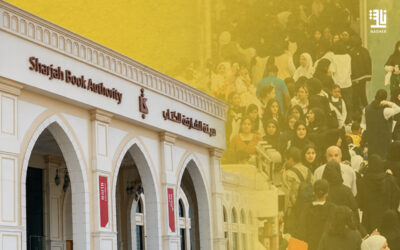
In retrospect, both speakers perhaps went too far in order to make a point. Sharjah is the first Gulf city to be named UNESCO World Book Capital, a title it may not have received if publishing – at least in this part of the Arab World – was really as bad as Barghouti maintains. Equally, publishers from across the region have been meeting informally in a loose group called ‘Publishers for the Future of Publishing’ to discuss long-standing concerns such as piracy, so there is action taking place to tackle the ‘crisis’ that Barghouti mentioned.
Similarly, when Haddad maintains that “the absence of the critical mind puts our Arab human being outside the realms of the imagination, art, literature, poetry, philosophy and thought”, this is surely to ignore the long and noble tradition of Arab poetry that has certainly exercised the imagination across the centuries.
But on one point everyone can agree: both addresses made for thought-provoking and provocative starts to each day and for that the IPA and the Union of Jordanian Publishers deserve praise.