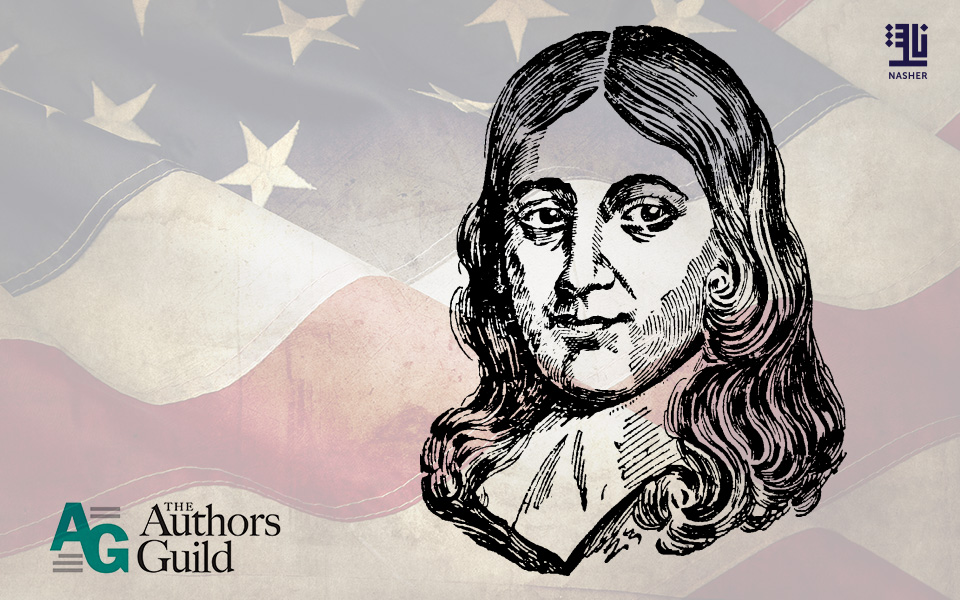
Whether those calling for a restructuring of the US book industry – and in particular, a long hard look at the power of Amazon – would go as far as to describe the current status quo as a paradise lost is not clear, but the Authors Guild has certainly cited the British poet and writer and author of that seminal work in its long, passionate letter to the Department of Justice, prompted by Bertelsmann’s move on Simon & Schuster
The letter says: “Perhaps no one has made the case better than the poet and political journalist John Milton, in Areopagitica, his foundational argument against concentration of power over the press, almost 400 years ago. He who ‘destroys a good book, destroys reason itself,’ Milton said. Concentration of power over authors, he added, threatens to ‘bring a famine upon our minds’.”
Would anyone suggest that in publishing today there is a “famine upon our minds”? There are dangers, yes – President Trump’s attempts to halt publication of books critical of him, the ‘no platform’ movements which arguably stifle debate – but these are separate from Amazon. Some might argue that Amazon’s help for the self-published – its ease with which it gives them a platform – and its own Amazon Publishing imprints (AmazonCrossing, Montlake Romance, Thomas & Mercer, 47North, et al) are feeding the industry, rather than creating a famine.
But others argue, as the letter does, that “with decisions about what gets published and marketed widely (and so becomes discoverable) in the hands of so few, there is no doubt that many important books won’t get published, or even written. Every time a publisher is acquired by another, we ensure there will be less diversity in the kinds of books read and the ideas exchanged.’ And so the debate goes back and forth.
The letter cites other historic figures besides Milton. In words that some might describe as hyperbolic – and yet which are true – it notes: “With their ability to transmit and disseminate ideas and knowledge, books can have profound implications for the advancement of humankind, the exchange of ideas, civic discourse, and the maintenance of democracy. For example, the Founders of the American Republic were significantly influenced by books authored by John Locke, Charles de Montesquieu, Jean Jacques-Rousseau, and Adam Smith. The Revolution itself was inspired to a large degree by the publication of Tom Paine’s Common Sense. Recently, the Black Lives Matter movement was greatly influenced by a number of books addressing racism in the U.S.”
So a debate over whether a publishing group should buy another publisher is referencing the founders of the American Republic, a seventeenth century British poet and the very future of democracy itself. Heady stuff. Do any such protests work? Well, the US Federal Trade Commission (FTC) blocked one such takeover in 2000 when Barnes & Noble tried to purchase the book distributor Ingram. At the time, the chairman of the FTC Robert Pitofsky said: “If somebody monopolizes the cosmetics fields, they’re going to take money out of consumers’ pockets, but the implications for democratic values are zero. On the other hand, if they monopolize books, you’re talking about implications that go way beyond what the wholesale price of the books might be.”
The current debate is certainly compelling to follow, all the more so because of the wider questions it highlights about freedom of speech, democracy and access to knowledge. It also shows – 250 years after the founding of America and 350 years after Milton walked the streets of London – the reverence with which books are held, and that of course, is to be celebrated.