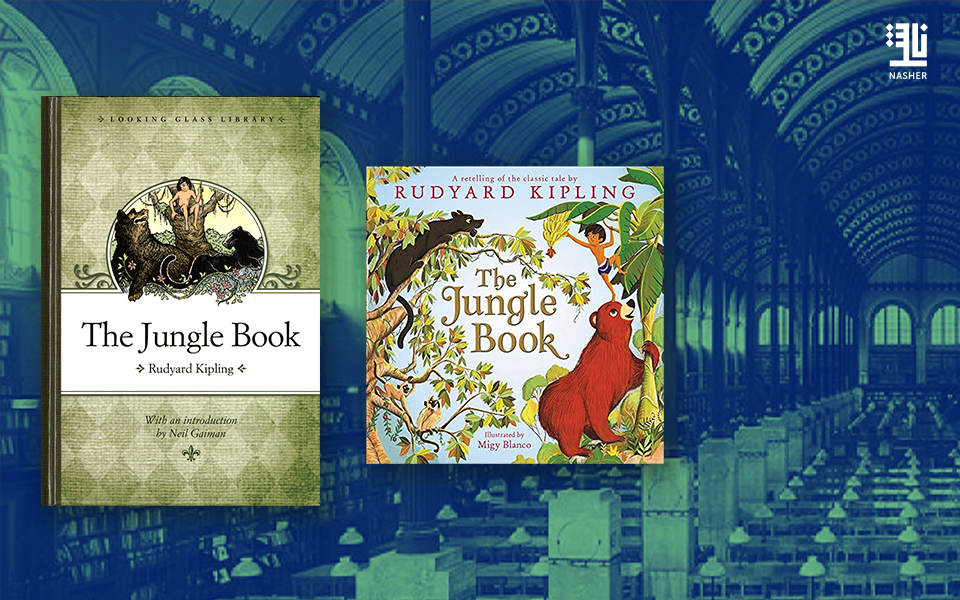
Page proofs of The Jungle Book by Rudyard Kipling have been allocated to Cambridge University Library, where they join his manuscript of the poem If, which was donated by the author himself.
The proofs from The Jungle Book are part of a collection that came to the library from the estate of the late Rosemary Watt, with its contents originally associated with Victorian literary agent AP Watt (1838-1914) and his son AS Watt (1870-1948). The Jungle Book, published in 1894, inspired Disney’s 1967 cartoon film of the same name and a 2016 remake.
They were awarded through the government’s Acceptance in Lieu scheme, external where inheritance tax bills are written off in exchange for important cultural, scientific or historic objects. Sir Chris Bryant, arts minister, said: “The Jungle Book is a family classic that has spawned countless other works, including the famous Disney 1967 cartoon film and the 2016 film.
“Now that these proofs will be available at Cambridge University Library, I’m sure they will provide more than the bare necessities for academics, aspiring novelists and self-confessed bookworms. “Through the Acceptance in Lieu scheme, Cambridge University Library will have the opportunity to showcase and contextualise these works so that members of the public can be educated, inspired and entertained by them for years to come.”
The collection from AP Watt features multiple volumes of Kipling proofs, including Rewards and Fairies and Puck of Pook’s Hill. Kipling, whose views on colonialism and the Empire have led to a more critical reinterpretation of his life and work in the 21st century, was perhaps the most beloved British author of the late 19th and early 20th centuries.
In 1907, he became the first English-language writer to receive the Nobel Prize for Literature. The collection also includes an array of manuscripts by once famed writers from the 1870s to the 1920s, such as novelist Sir Walter Besant co-founder and chairman of the Society of Authors. The Watt collection joins other Kipling material already at Cambridge University Library, including his corrected autograph manuscript of perhaps his most celebrated work, the poem If, which has regularly been voted as one of the UK’s favourite poems.
John Wells, senior archivist at Cambridge University Library, said: “Taken together, the treasures found in the AP Watt collection are an exceptional accumulation of manuscripts and proofs of commercial prose from an era widely regarded as the heyday of the popular novel in this country. “While Kipling’s legacy has been scrutinised more closely over recent years, there is little argument about his presence and place in the UK’s literary history or the enduring popularity of many of his works.
“The inclusion of the annotated proof of Kipling’s Rewards and Fairies (1910) is of special interest to the library since in 1926 we received a donation from Kipling of the autographed manuscript of this book.
“The manuscript includes Kipling’s instructions to the printers, so we assume it to be the copy supplied to the printers for setting the proofs. “The proofs in the Watt collection bear Kipling’s manuscript corrections, and together, the two items represent the interchange of texts between author and printers that resulted in the published volume. As part of the collection, the university’s Pembroke College was also allocated a travelling writing desk which belonged to Wilkie Collins, author of The Woman in White and The Moonstone.
Nick Watt, AP Watt’s great-great grandson, said: “The Watt family are delighted that the AP Watt Collection will now remain in the UK, freely accessible for research into the contribution made by our great-great grandfather and great grandfather to the literary world of the late 19th and early 20th centuries.”