
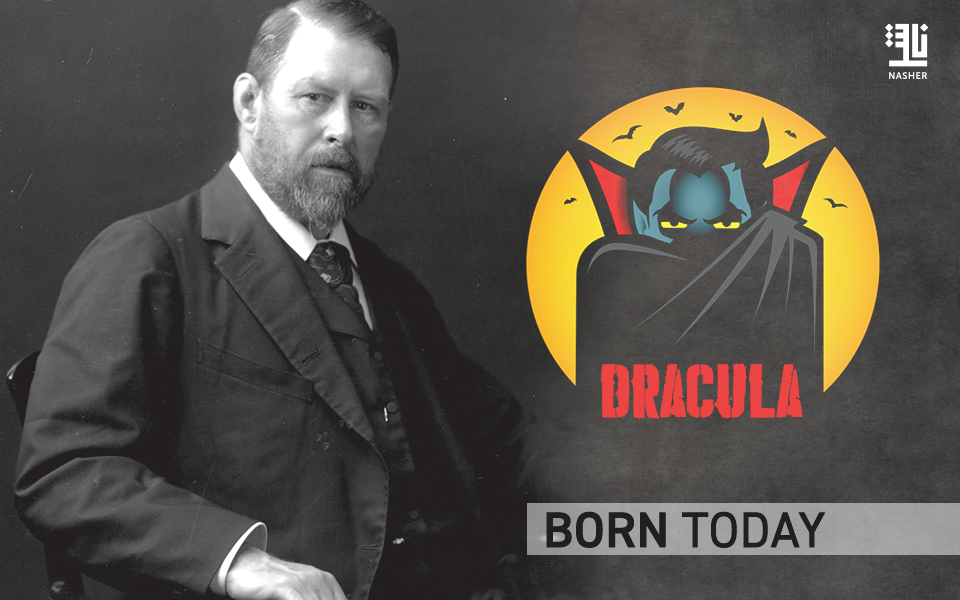
Stoker was born Abraham Stoker on November 8, 1847, in Dublin, Ireland, to father Abraham Stoker and mother Charlotte Matilda Blake Thornley Stoker. One of seven children, Stoker suffered from a mystery illness which left him confined to bed and unable to walk. What caused this illness has been much speculated on but never solved. He was cured of his illness as he grew to adulthood. It had no lasting effects on him as he went on to become a champion rugby player and athlete in his college years.
In 1864, Stoker enrolled at the University of Dublin and attended the university’s sole constituency, Trinity College. He studied mathematics at Trinity, graduating with honours in 1870. It was during that time when Stoker and Wilde met each other at Trinity College in Dublin when they were both students; Stoker even proposed Wilde’s membership at the school’s Philosophical Society. But when his childhood sweetheart, Florence Balcome, decided to marry Stoker, Wilde left Ireland and moved to England. Florence, Bram Stoker’s wife, had been engaged to Oscar Wilde but left him to marry Stoker. In the novel Dracula, Johnathon Harker and Count Dracula are locked in a type of love triangle with Harker’s fiancée Mina Murray. At the time Stoker was writing the novel, Wilde was tried and found guilty of “committing acts of gross indecency with other male persons” and was sentenced to two years in jail. His trial caused a media sensation and revealed lurid details about Wilde’s ‘degenerate’ lifestyle.
Some have spotted similarities with the novel Dracula: seeing the dutiful Harker as Stoker, and the debased Count Dracula as Oscar Wilde. Stoker and Balcombe remained married until Stoker’s death.
In the end, Wilde didn’t hold a grudge, and Stoker visited him in France, where he lived for three years before his death.
Stoker started off as a civil servant–and a theatre critic. His review of Hamlet impressed the star, Henry Irving, who invited him to dinner. They became friends, and a few years later, he wound up managing Irving’s theatre, the Lyceum Theatre, as well as Irving’s career.
In the day, authors travelled on literary tours. Stoker’s trips revolved around managing his client. But while they were in the United States, Stoker got to meet presidents Theodore Roosevelt and William McKinley, as well as poet Walt Whitman.
In 1875, Stoker published what became his first novel, The Primrose Path. He continued to publish writings while managing the successful Lyceum Theatre, including the short story collection Under the Sunset (1882) and his second novel, The Snake’s Pass (1890), earning modest acclaim. More notably, he garnered public praise for his many roles dedicated to the arts.
In 1897, Stoker published his masterpiece, Dracula. While the book garnered critical success after its release, it didn’t achieve peak popularity until well after its author’s death. Dracula was inspired by an essay by Emily Gerard, “Transylvania Superstitions.”
Stoker never visited Eastern Europe, so he had to rely on his journalist skills for his novel’s background. He spent seven years on research. His Hungarian friend, Ármin Vámbéry, also theoretically consulted with Stoker on Transylvanian culture. The name Dracula was inspired by William Wilkinson’s book, Account of the Principalities of Wallachia and Moldavia with Political Observations Relative to Them–the name of the descendants of Vlad II of Wallachia.
(Before the book was called Dracula, it was originally called The Dead Un-dead. It went to the publishers under the name The Un-Dead. Another fun fact about Dracula: The original 541-page manuscript was found in a barn in Pennsylvania with the title The Un-Dead. Bram Stoker published Dracula when he was 50 years old.
After Dracula, Stoker continued to churn out an array of fiction and nonfiction works. He wrote a total of 12 novels in his lifetime, his later efforts including Miss Betty (1898), The Mystery of the Sea (1902), The Jewel of Seven Stars (1904) and The Lair of the White Worm (1911), which was later published under the title The Garden of Evil.
Stoker died in London, England, on April 20, 1912, with various reports citing the cause as complications from a stroke, exhaustion or syphilis. He was cremated, and later, his ashes were joined by the ashes of his son, Noel. You can visit them at Golders Green Crematorium, the first crematorium in London.