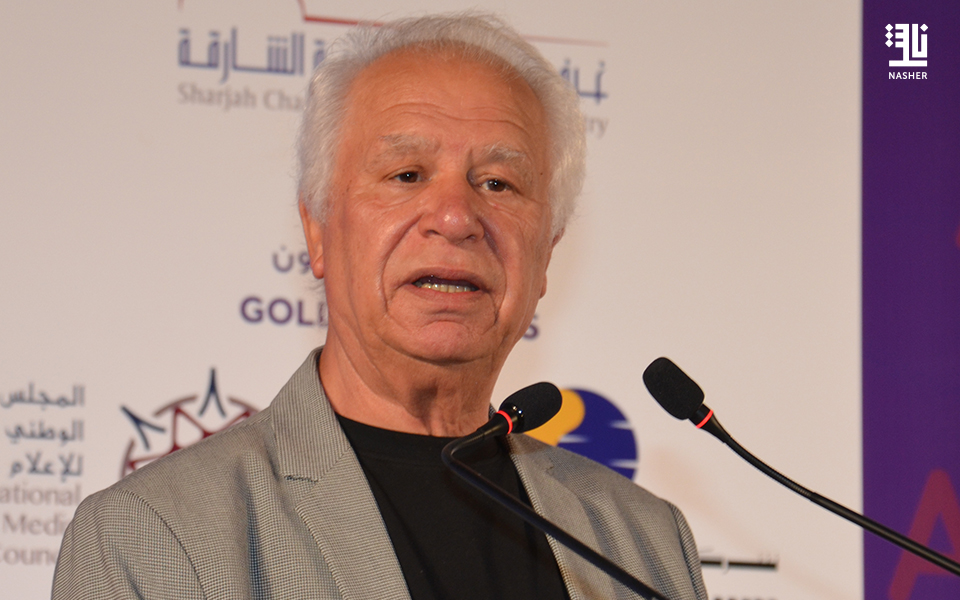
In one of his last major speeches before he died the Palestinian poet and writer Mourid Barghouti who passed away on 14 February aged 77, addressed what he called “the crisis of publishing in the Arab world.”
He was giving a keynote address at the International Publishers Association’s Middle East seminar held in the Jordanian capital Amman in September 2019.
It was an uncompromising speech which was frank in its criticism of some Arab publishers and which talked much about the lasting influence of colonialism. He said that the word crisis could describe many aspects of Arab society and that the region was suffering the effects of “neo-colonialism, settler colonialism and economic colonialism.”
He said that every aspect of Arab life was touched by crisis. “There is a crisis of freedom of movement and freedom of speech. There is a crisis because we cannot agree on a peaceful mechanism for the transition of power…Most alarming of all is the crisis of hegemonic foreign powers attempting to force us into total subordination.”
He recalled chairing the judges for the International Prize for Arabic Fiction in 2015 when he despaired that “several works were nominated by publishing houses which seem to have been established for the sole purpose of submitting an entry to the competition…Some publishing houses procure sums of money from writers in exchange for publishing a novel.”
He deplored the lack of literary editors in Arab publishing houses, adding that the few who do recruit their own literary editors “are usually shocked to find that Arab writers, unaccustomed to this tradition, refuse to cooperate with the editor”. He also lamented the lack of literary agents in the region “which has inflicted upon us a breed to writers have to go from door to door with their manuscripts to see if a publisher would be interested. This amounts to begging, and it not becoming of a self-respecting writer to beg.”
Colonialism has resulted in nation states which make it “difficult for books to travel across borders – [they] are treated much the same way as imported goods. As a result of these tight restrictions on book imports, an underground industry has flourished which is based on producing fraudulent, and almost always bad, copies of original books.”
He also said that he was “deeply saddened” by the decline in publishers of children’s books in the region. In particular, he lamented the disappearance of Dar Al-Fata Al-Arabi (1974-1994) and called for publishing houses to give a focus to children’s literature.
Barghouti was born in 1944 in a village near Ramallah, Palestine. He spent much of his life in exile and wrote about the experience in his celebrated memoir I Saw Ramallah. Barghouti was studying in Cairo when the 1967 Arab-Israeli war broke out and he did not return to his birthplace for another 30 years. He settled in Cairo with his Egyptian wife Radwa Ashour, herself an author who translated many of his poems into English. Their son Tamim al-Barghouti is also a poet
Mourid Barghouti wrote 12 collections of poetry. His passing has been widely mourned in the Arab-speaking world and beyond. The Palestinian Minister for Culture Atef Abu Seif said that Palestinians and Arabs had “lost a symbol of national struggle and creativity. [Barghouti] was one of the creative people who devoted their writings and creativity in defence of the Palestinian cause, the story and struggle of our people, and Jerusalem, the capital of the Palestinian existence.”