One might be deceived to think that the literary world is different to other fields, with most people believing that it is dominated by love and morality but this is not entirely true. The literary circle is full of rivalry and envy and most importantly blatant criticism of each other’s work. There are many authors who had long standing feud with other authors and one could go as far as saying hated them. In our series of Authors At War we have chosen five authors who were open about their dislike of their fellow writers.
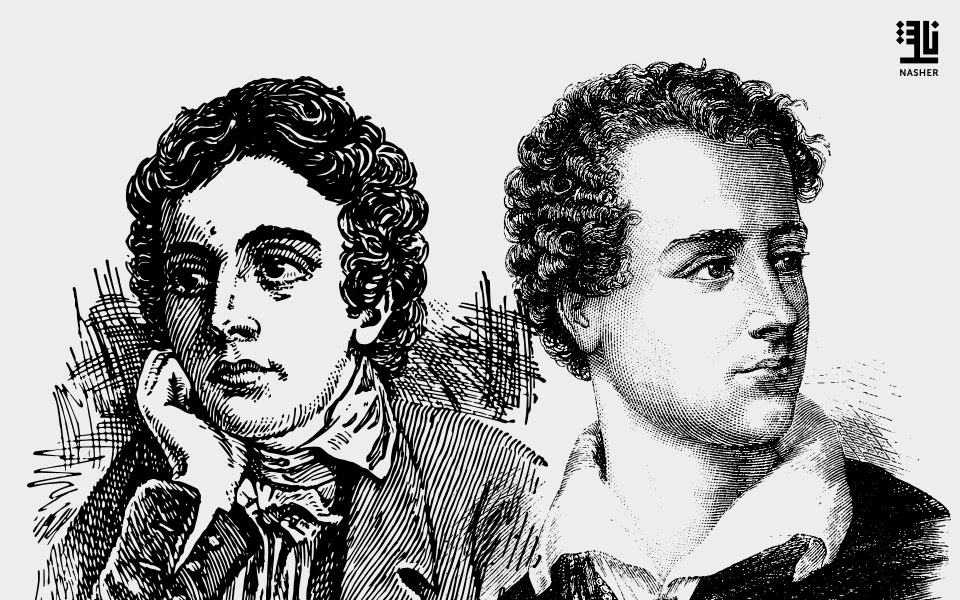
We begin our series with a battle between two of England’s greatest poets, John Keats and Lord George Byron. Both poets belonged to the 19th century British Romantic movement, yet they were so vastly different, its hard to imagine they were associated with the same genre.
John Keats and Lord Byron feud had more of a rivalry aspect rather than hate. Byron was a flamboyant and handsome nobleman whose wit, charm and ancestral title gave him access to the most elite circles of English society, Byron was simply a snob with so many privileges that he did not work hard to gain. Keats on the other hand was a poor and struggling middle-class poet whose work was often savaged by the great critics of the age, so naturally there was an element of jealousy of Byron’s success. Neither liked the other’s work, and both were very bitter about it.
Keats died of tuberculosis at the mere age of 25 years old, and some of his friends, including Percy Shelley, claimed that his death had been hastened by the stress caused by negative reviews of his work in The Quarterly Review. Byron found that hilarious.
Prior to his death John Keats wrote a letter to his brother George in September 1819, where he addressed the differences between himself and Byron ‘You speak of Lord Byron and me – There is this great difference between us. He describes what he sees – I describe what I imagine – Mine is the hardest task.’ The rivalry and envy are quite clear from the manner Keats wrote this letter and its also evident that this rivalry was more acutely felt by Keats.
Keats death did not seem to change how Byron felt or put an end to this long going rivalry, in fact after Byron learnt of Keats passing away and the reason of his death – stress at receiving negative reviews – Byron found it hilarious and in poor taste even made fun of Keats, posthumously, in his famous poem Don Juan:
“John Keats, who was killed off by one critique, Just as he really promised something great,
If not intelligible, —without Greek, Contrived to talk about the Gods of late,
Much as they might have been supposed to speak. Poor fellow! His was an untoward fate: —
‘Tis strange the mind, that very fiery particle, Should let itself be snuffed out by an Article.”
It is hard to judge who was at fault for this feud and how it started but it does seem that being of a higher social class does not always get reflected in the behaviour of the individual as demonstrated by Lord Byron’s action after Keats death.
Raya AlJadir