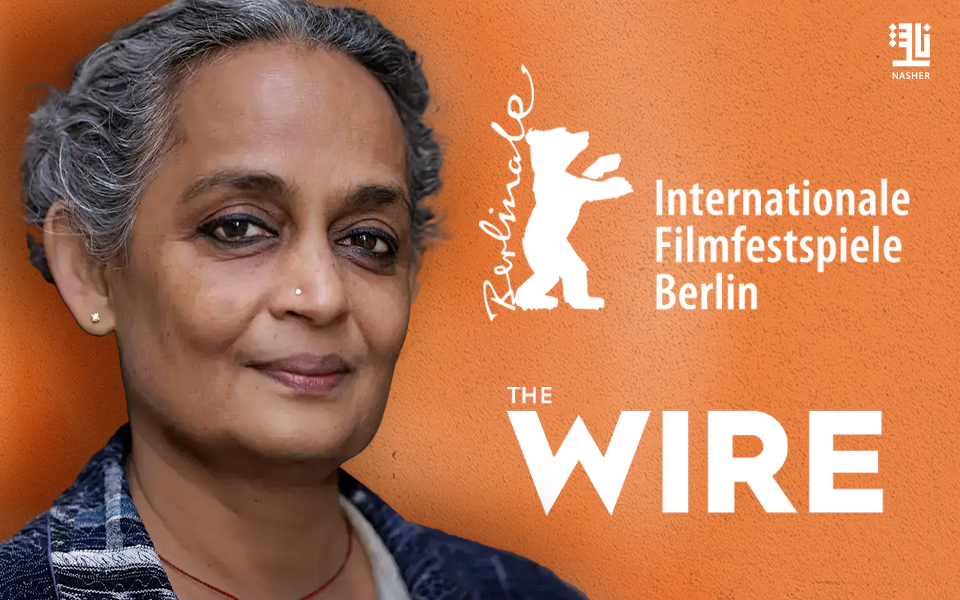
Award-winning Indian author Arundhati Roy has withdrawn from the Berlinale after the film festival’s chief juror said film-makers must stay out of politics.
Writing in India’s The Wire newspaper, Roy said she found recent remarks from members of the Berlinale jury, including its chair, acclaimed director Wim Wenders, that “art should not be political” to be “jaw-dropping”.
“It is a way of shutting down a conversation about a crime against humanity even as it unfolds before us in real time,” wrote Roy, the author of novels and nonfiction, including The God of Small Things.
The festival got off to a shaky start after the competition jury, led by the German film-maker Wim Wenders, fielded questions about the conflict in Gaza. Asked if films can affect political change, Wenders said that “movies can change the world” but “not in a political way”.
He added that film-makers “have to stay out of politics because if we make movies that are dedicatedly political, we enter the field of politics. But we are the counterweight of politics, we are the opposite of politics. We have to do the work of people, not the work of politicians.”
In a statement announcing her withdrawal, Roy, who had been planning to attend a screening of her recently restored 1989 film In Which Annie Gives it Those Ones, called the comments “unconscionable” and feared they had reached “millions of people across the world”.
The Booker prize-winning Indian author said: “To hear them say that art should not be political is jaw-dropping. It is a way of shutting down a conversation about a crime against humanity even as it unfolds before us in real time – when artists, writers and film-makers should be doing everything in their power to stop it.”
She added: “Although I have been profoundly disturbed by the positions taken by the German government and various German cultural institutions on Palestine, I have always received political solidarity when I have spoken to German audiences about my views on the genocide in Gaza.”
Wenders is the serving president of this year’s Berlinale jury, which includes the American director-producer Reinaldo Marcus Green, the Japanese film-maker Hikari, the Nepalese director Min Bahadur Bham, the South Korean actor Bae Doona, the Indian director-producer Shivendra Singh Dungarpur, and Ewa Puszczyńska – who produced Oscar-winning film The Zone of Interest, about the idyllic home life of an Auschwitz commandant and his family.
Roy, who was this week longlisted for the Women’s prize for non-fiction for her first memoir, Mother Mary Comes to Me, emphasised her belief that “what has happened in Gaza, what continues to happen, is a genocide of the Palestinian people by the state of Israel”.
She added: “It is supported and funded by the governments of the United States and Germany, as well as several other countries in Europe, which makes them complicit in the crime. If the greatest film-makers and artists of our time cannot stand up and say so, they should know that history will judge them. I am shocked and disgusted.”
Roy had been due to participate in the festival, which runs from February 12 to 22, after her 1989 film, In Which Annie Gives It Those Ones, was selected to be screened in the Classics section.
Germany, which is one of the biggest exporters of weapons to Israel, after the US, has introduced harsh measures to prevent people from speaking out in solidarity with Palestinians.
In 2024, more than 500 international artists, filmmakers, writers and culture workers called on creatives to stop working with German-funded cultural institutions over what they described as “McCarthyist policies that suppress freedom of expression, specifically expressions of solidarity with Palestine”.
“Cultural institutions are surveilling social media, petitions, open letters and public statements for expressions of solidarity with Palestine in order to weed out cultural workers who do not echo Germany’s unequivocal support of Israel,” organisers of the initiative said.