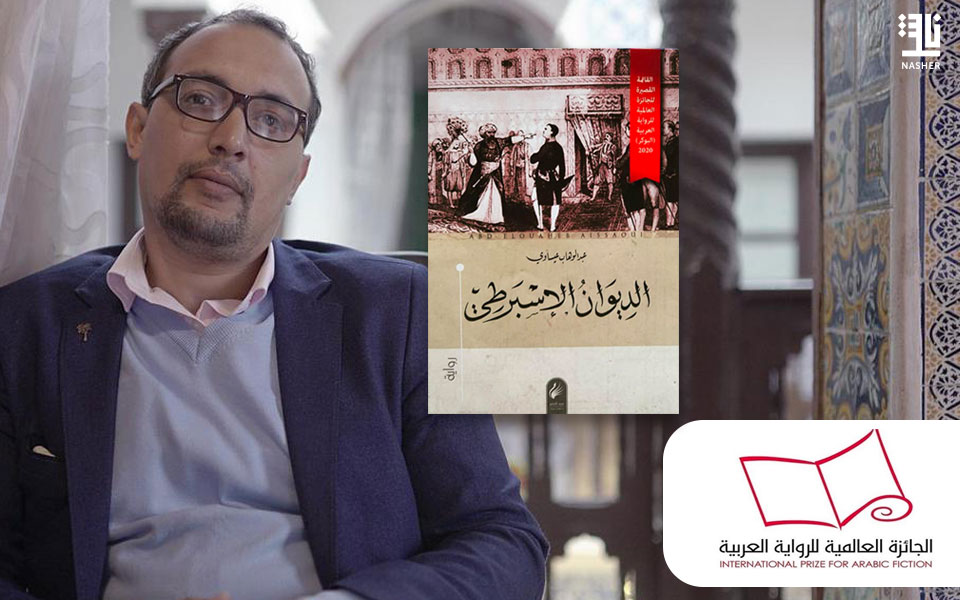
The Spartan Court by Abdelouahab Aissaoui was announced as the winner of the 13th International Prize for Arabic Fiction (IPAF). The novel, published by Dar Mim, was named as this year’s winner by the Chair of Judges, Muhsin al-Musawi.
In addition to winning USD $50,000, funding will be provided for the English translation of The Spartan Court, and Abdelouahab Aissaoui can expect an increase in book sales and international recognition.
Muhsin al-Musawi, Chair of the 2020 Judging Panel, says:
“The Spartan Court stands out for its stylistic brilliance. It is polyphonic – with multiple voices telling the story. Readers gain a multi-layered insight into the historical occupation of Algeria and, from this, the conflicts of the entire Mediterranean region, with characters embodying different interests and intersecting visions. The novel invites the reader to gain a greater understanding of life under occupation and the different forms of resistance that grow against it. With its deep, historical narrative structure, the novel does not live in the past, but rather it challenges the reader to question present reality.”
Professor Yasir Suleiman CBE, Chair of the Board of Trustees, says:
“The Spartan Court is a captivating tale, a tale of many voices, truths and falsehoods. It goes back in history to excavate the past and permeate the present with intertwined narratives that keep the reader glued to its enchanting characters and their tortuous fortunes. Its many bittersweet vignettes, and their rootedness in place and time draw the reader to worlds with myriad tones of colour, sound and smell. Abdelouahab Aissaoui has given us a work to celebrate and remember during these anguished times. For this we are grateful to him.”
The Spartan Court follows the interconnected lives of five characters in Algiers from 1815 to 1833. The first, Dupond, is a French journalist covering the colonial campaign against Algeria, and the second, Caviard, is a former soldier in Napoleon’s army who finds himself a prisoner in the city and later becomes a planner for the campaign. The other three Algerian characters have different attitudes to the Ottoman and French colonial powers. Ibn Mayyar thinks that politics is a means of building relationships with the Ottomans and even the French, whilst Hamma al-Sallaoui believes that revolution is the only means of achieving change. The fifth character, Douja, is suspended somewhere between all these: she witnesses the transformation of Algiers helplessly and is forced to become a part of it, for one must live according to the city’s rules, or leave.
The Spartan Court was chosen by the IPAF judges as the best work of fiction published between July 2018 and June 2019 from a shortlist of six novels by authors from Algeria, Egypt, Iraq, Lebanon and Syria. The shortlisted finalists – Abdelouahab Aissaoui, Khalil Alrez, Jabbour Douaihy, Said Khatibi, Alia Mamdouh and Youssef Ziedan – will receive USD $10,000.
The International Prize for Arabic Fiction is an annual literary prize for prose fiction in Arabic. It is sponsored by the Department of Culture and Tourism – Abu Dhabi and is run with the support, as its mentor, of the Booker Prize Foundation in London.